






 9M2D
9M2D
SERF1_HUMAN short isoform of Small EDRK-rich factor 1, serf1a at pH 6.8.
Summary for 9M2D
| Entry DOI | 10.2210/pdb9m2d/pdb |
| Descriptor | Isoform Short of Small EDRK-rich factor 1 (1 entity in total) |
| Functional Keywords | rna-binding protein, intrinsic disorder protein, and neurological disorders., nuclear protein |
| Biological source | Homo sapiens (human) |
| Total number of polymer chains | 1 |
| Total formula weight | 7499.58 |
| Authors | Huang, S.Y.,Shih, O.,Jeng, U.S.,Chang, C.F.,Lin, J.H.,Malliavin, T.E. (deposition date: 2025-02-27, release date: 2026-01-14, Last modification date: 2026-02-18) |
| Primary citation | Huang, S.Y.,Shih, O.,Jeng, U.S.,Chang, C.F.,Lin, J.H.,Malliavin, T.E. pH Sensitivity of the SERF1a Conformational Ensemble. Acs Omega, 11:2614-2627, 2026 Cited by PubMed Abstract: The MOAG-4/SERF class of proteins is a positive regulator of the aggregate formation of amyloid proteins that play an important role in the origin of numerous age-related diseases. In this class of proteins, previous structural studies showed that SERF1a is a very flexible protein, containing at least one α-helical region. The present work proposes the first description of the conformational space of SERF1a at two pH values (6 and 6.8) using nuclear magnetic resonance (NMR) and small-angle X-ray scattering (SAXS). SERF1a NMR conformations have been generated using the CYANA-FLYA procedure as well as the TAiBP (Threading-Augmented interval Branch-and-Prune) procedure, based on the systematic enumeration of protein conformations within an original distance geometry scheme. The generated conformations were filtered using Pepsi-SAXS by fitting small-angle X-ray experiments based on size exclusion chromatography (SEC-SAXS). At pH 6.8, a good fit of the SEC-SAXS curves was obtained for the CYANA and TAiBP NMR conformations, while at pH 6, analysis of the NMR conformations and the SEC-SAXS curves indicated that there could be a conformational exchange between a compact conformation displaying long-range nuclear Overhauser effects (NOEs) between residues LYS-13 and THR-32, and slightly more extended conformations. The shortening of the C-terminal α-helix, as well as the destabilization of the N-terminal α-helix at acidic pH, may be related to the physiological function of SERF1a in the nucleoli. Interestingly, the N-terminal region of SERF1a displays numerous possible binding pockets, particularly in the region interacting with α-synuclein, detected by chemical shift perturbations. In general, the TAiBP procedure allows for a more expanded exploration of the SERF1a conformational space as well as for a description of the internal dynamics of SERF1a in agreement with NMR relaxation and with predictions from the protein primary sequence. PubMed: 41585721DOI: 10.1021/acsomega.5c07620 PDB entries with the same primary citation |
| Experimental method | SOLUTION NMR |
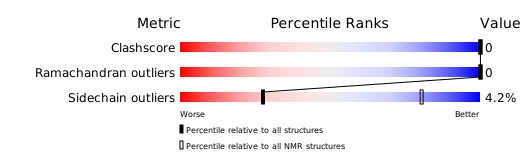
Structure validation
Download full validation report


