






 9LYJ
9LYJ
Cryo-EM structure of MdtF
Summary for 9LYJ
| Entry DOI | 10.2210/pdb9lyj/pdb |
| EMDB information | 63315 |
| Descriptor | Multidrug resistance protein MdtF, DODECYL-BETA-D-MALTOSIDE (2 entities in total) |
| Functional Keywords | membrane protein, e.coli., cryo-em, efflux pump., transport protein |
| Biological source | Escherichia coli K-12 |
| Total number of polymer chains | 3 |
| Total formula weight | 336306.67 |
| Authors | Dutta, S.,Padmanaban, S.,Fernando, R.C. (deposition date: 2025-02-20, release date: 2025-12-10, Last modification date: 2026-01-28) |
| Primary citation | Padmanaban, S.,Rencilin, C.F.,Biswas, R.,Dutta, S. Cryo-EM reveals the structural heterogeneity and conformational flexibility of multidrug efflux pumps MdtB and MdtF. Mbio, 17:e0268425-e0268425, 2026 Cited by PubMed Abstract: Resistance-nodulation-cell division (RND) efflux pumps are the major cause of multidrug resistance in bacteria, particularly in Gram-negative bacteria. They are complex molecular machines forming tripartite assemblies that actively transport out a wide range of antimicrobial agents, including antibiotics, biocides, and host defense molecules. However, the presence of multiple RND transporters with overlapping functions in a single bacterium raises questions about their individual functional relevance. In this study, we determined the cryo-electron microscopy (cryo-EM) structures of two distinct hydrophobic and amphiphilic efflux (HAE)-RND transporters from MdtB and MdtF. MdtB transporter is a part of the two-RND subunit system MdtABC. MdtF is a unique class of RND transporter whose expression is regulated by oxygen availability and is crucial for the survival of in anaerobic growth conditions. The cryo-EM structures of MdtB and MdtF reveal a novel conformational state of HAE-RND efflux pumps. While the MdtB structure adopts an intermediate state, MdtF displays structural dynamics in the presence of n-dodecyl-β-D-maltoside (DDM). MdtF at 2.8 Å resolution displayed a significant conformational change in the transmembrane core helices and flexibility in the transmembrane domain. Our findings highlight the significance of the novel structural state during the substrate transport mechanism. Furthermore, our structural analysis provides insights into drug-binding sites and the transport mechanism of these important transporters. PubMed: 41370088DOI: 10.1128/mbio.02684-25 PDB entries with the same primary citation |
| Experimental method | ELECTRON MICROSCOPY (3.14 Å) |
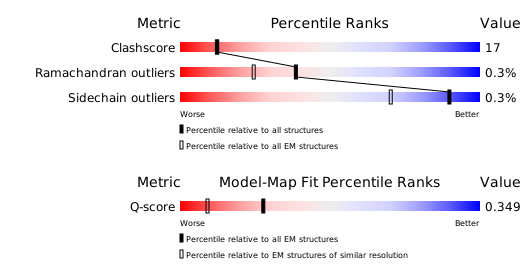
Structure validation
Download full validation report


