






 9LYI
9LYI
Cryo-EM structure of collagenase H (E416Q mutant) from Hathewaya histolytica in complex with collagen model peptide (Pro-Hyp-Gly)12
Summary for 9LYI
| Entry DOI | 10.2210/pdb9lyi/pdb |
| EMDB information | 63511 |
| Descriptor | Collagenase ColH, (Pro-Hyp-Gly)12, CALCIUM ION, ... (5 entities in total) |
| Functional Keywords | collagenase, hathewaya histolytica, clostridium histolyticum, metal binding protein |
| Biological source | Hathewaya histolytica More |
| Total number of polymer chains | 4 |
| Total formula weight | 122126.91 |
| Authors | Oki, H.,Kawahara, K. (deposition date: 2025-02-20, release date: 2026-04-15, Last modification date: 2026-07-01) |
| Primary citation | Oki, H.,Takebe, K.,Bonsu, A.,Fujii, K.,Masuda, R.,Henderson, N.,Mima, T.,Koide, T.,Moradi, M.,Matsushita, O.,Sakon, J.,Kawahara, K. Bacterial collagenase harnesses collagen geometry for processive cleavage. Nat Commun, 17:-, 2026 Cited by PubMed Abstract: Collagen, the major structural protein in the animal extracellular matrix, forms a triple helix that resists proteolysis and requires specialised enzymes for degradation. Flesh-eating bacteria secrete collagenases that unwind the collagen triple helix and processively trim Gly-X-Y triplet repeats, yet the molecular basis of this process has remained obscure. Here, cryo-electron microscopy reveals how Hathewaya histolytica collagenase ColH engages its substrate and exploits the helix's architecture for catalysis. ColH encircles a single collagen triple helix in a closed-ring conformation and, through dynamic domain motions, dehydrates and destabilises it. The enzyme undergoes substrate-assisted twisting to adopt a rigid ratcheted conformation, in which one chain is bent into a tripeptide-long 'bight' and threaded into the active site for cleavage, while two uncut strands are partitioned to non-catalytic sites. Release of the bight appears to reset the enzyme, with the uncut strands serving as guiding tracks. Repeated cycling between dynamic and rigid states likely enables triplet-by-triplet translocation, allowing ColH to harness collagen's geometry for processive degradation. These findings reveal a bacterial strategy for collagen unwinding and cleavage distinct from that of mammalian collagenases, highlighting divergent evolutionary solutions for degrading one of nature's most intractable substrates. PubMed: 41927550DOI: 10.1038/s41467-026-71099-3 PDB entries with the same primary citation |
| Experimental method | ELECTRON MICROSCOPY (2.8 Å) |
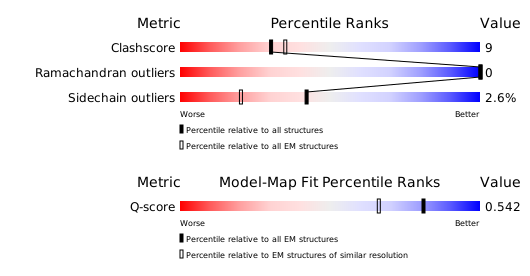
Structure validation
Download full validation report


