






 9LUK
9LUK
Crystal structure of Switchbody based on anti-osteocalcin antibody KTM219 Fab
Summary for 9LUK
| Entry DOI | 10.2210/pdb9luk/pdb |
| Related | 5X5X 8XS1 |
| Descriptor | Heavy chain fragment (Fd) of anti-osteocalcin antibody KTM219 with N-terminal HiBiT, Light chain of anti-osteocalcin antibody KTM219, GLYCEROL, ... (4 entities in total) |
| Functional Keywords | antibody, hibit, immunoassay, immunoglobulin fold, luciferase, osteocalcin, switchbody, immune system |
| Biological source | Mus musculus More |
| Total number of polymer chains | 2 |
| Total formula weight | 54638.45 |
| Authors | Yazaki, S.,Yasuda, T.,Kitaguchi, T.,Ueda, H.,Arai, R. (deposition date: 2025-02-08, release date: 2025-10-08, Last modification date: 2025-12-10) |
| Primary citation | Yasuda, T.,Ueno, Y.,Taguchi, M.,Tochio, N.,Yagi, H.,Yazaki, S.,Arai, R.,Zhu, B.,Kigawa, T.,Ueda, H.,Kitaguchi, T. Switchbody, an Antigen-Responsive Enzyme Switch Based on Antibody and Its Working Principle. Adv Sci, 12:e08422-e08422, 2025 Cited by PubMed Abstract: An enzyme switch, termed "Switchbody", is developed by fusing an antibody with a fragment of a split enzyme for the precise regulation of enzyme activity in response to an antigen. A luciferase-based Switchbody is engineered by fusing the NanoLuc luciferase fragment HiBiT to the N-terminus of an antibody. The enzyme activity of the Switchbody increases upon the addition of an antigen in a dose-dependent manner in the presence of the complementary fragment LgBiT and its substrate furimazine, demonstrating the potential of the luciferase-based Switchbody as a biosensor. As its working principle, ELISA shows that the interaction between HiBiT and LgBiT is facilitated by antigen binding. Moreover, X-ray crystallography and NMR reveal the heterogeneous trapped state of the HiBiT region and an increasing motility of HiBiT region upon antigen binding, respectively. MD simulations and luminescence measurements show that antigen disrupted the trapping of HiBiT in the antibody, enabling its release. By applying this "Trap and Release" principle to Protein M, an antibody-binding protein, label-free IgG antibodies are successfully converted into bioluminescent Switchbodies. This adaptable Switchbody platform has the potential to expand switching technology beyond luciferase to various other enzymes in the future. PubMed: 40953287DOI: 10.1002/advs.202508422 PDB entries with the same primary citation |
| Experimental method | X-RAY DIFFRACTION (1.95 Å) |
Structure validation
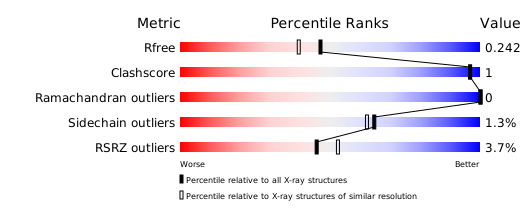
Download full validation report


