






 9LTO
9LTO
Cryo-EM structure of DDB1-DDA1-DET1-Ube2e2 complex
Summary for 9LTO
| Entry DOI | 10.2210/pdb9lto/pdb |
| EMDB information | 63371 63372 63374 |
| Descriptor | Ubiquitin-conjugating enzyme E2 E2, DNA damage-binding protein 1, DET1 homolog, ... (4 entities in total) |
| Functional Keywords | e3 ligase component, ligase |
| Biological source | Homo sapiens (human) More |
| Total number of polymer chains | 4 |
| Total formula weight | 225166.22 |
| Authors | |
| Primary citation | Wang, S.,Teng, F.,Stjepanovic, G.,Rao, F.,Su, M.Y. Cryo-EM structure of the human COP1-DET1 ubiquitin ligase complex. Nat Commun, 17:543-543, 2026 Cited by PubMed Abstract: Ubiquitin modifications regulate fundamental cellular activities by modulating protein stability and function. The ubiquitin ligase COP1, which is present across species from plants to humans, plays a crucial role in the ubiquitination of developmental transcription factors. While COP1 can function independently, it can also be incorporated into CULLIN4-RING ubiquitin ligase (CRL4) complexes through the DET1 adaptor protein. Despite its biological significance, the structural and functional mechanisms of COP1 and DET1-containing complexes remains poorly understood. Here we present the cryo-electron microscopy structures of human COP1 in complex with DDB1-DDA1-DET1 and Ube2e2, revealing an inactive stacked assembly state. Co-expression with COP1 substrates including c-Jun or ETS2 disrupts this configuration, inducing a conformational rearrangement into a distinct dimeric state that allows substrate access. Structural modelling identifies the spatial organization of COP1 WD40 domains where substrate recruits. DET1 serves as a structural scaffold, bridging COP1 and Ube2e2 to initiate potential ubiquitin addition on substrates, while DDB1 recruits the CULLIN4-RBX1 complex to facilitate Ube2d3-mediated ubiquitin chain elongation. These results reveal the dynamic interplay between the structural states of the CRL4 E3 ligase complex and its substrate specific activation mechanism, offering mechanistic insights into ubiquitination regulation and a basis for future studies on E3 ligase dynamics. PubMed: 41540009DOI: 10.1038/s41467-026-68375-7 PDB entries with the same primary citation |
| Experimental method | ELECTRON MICROSCOPY (2.92 Å) |
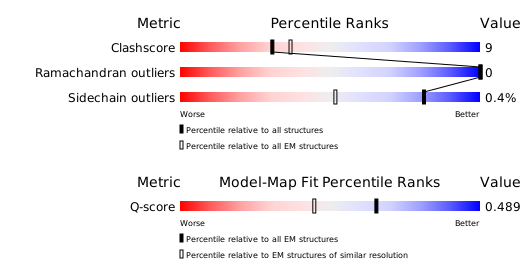
Structure validation
Download full validation report


