






 9LTG
9LTG
Crystal structure of H-2Kb with C.parvum peptide
Summary for 9LTG
| Entry DOI | 10.2210/pdb9ltg/pdb |
| Descriptor | H-2 class I histocompatibility antigen, K-B alpha chain, Beta-2-microglobulin, PHE-LEU-PHE-LEU-PHE-GLU-ASN-VAL, ... (5 entities in total) |
| Functional Keywords | mhc, immunology, immune system |
| Biological source | Mus musculus (house mouse) More |
| Total number of polymer chains | 12 |
| Total formula weight | 178761.12 |
| Authors | |
| Primary citation | Fan, S.,Peng, J.,Kang, C.,Wang, T.,Ren, S.,Li, L.,Zhao, Y.,Tian, P.,Bu, Y.,Yan, Y.,Xia, R.,Wu, C.,Wang, H.,Wang, Y. Structural basis for the lack of immunogenicity of a Cryptosporidium octapeptide: anchor switching induces MHC-I groove remodeling and instability. Int.J.Biol.Macromol., 375:153155-153155, 2026 Cited by PubMed Abstract: Cryptosporidium parvum is an intracellular protozoan parasite causes severe diarrheal disease, particularly in immunocompromised individuals, underscoring the importance of host immunity in controling infection. Here, we elucidate the structural basis for the poor immunogenicity of the C. parvum MEDLE2-derived octapeptide FLF8 (FLFLFENV) bound to the mouse H-2K molecule. X-ray crystallography of the H-2K-FLF8 complex revealed a non-canonical anchoring mode: the P1-Phe occupies the B and C pockets, bypassing the A pocket, while the P2-Leu inserts into the A and D pockets without forming hydrogen bonds with the B pocket. This topology deviates from the canonical anchoring pattern and correlates with reduced thermal stability of the wild-type H-2K-FLF8 complex (T = 35.03 °C), which was improved by F1A (T = 37.78 °C) and L2N (T = 42.57 °C) mutations. Structural analysis indicates that a severe steric clash between the bulky P1-Phe and P2-Leu side chains forces a unique groove remodeling, characterized by a restricted A-pocket and Y159 reorientation. This adaptation is distinct from all known H-2K structures and other MHC-I alleles and may function as a unique "structural stress" specific to H-2K. AlphaFold3 modeling suggests that these alterations attenuate TCR-pMHC interfacial interactions, consistent with the observed deficiencies in CD8 T-cell responses. Our findings suggest that the anchor residue switching may enable C. parvum to evade CD8 T-cell recognition through conformational plasticity that destabilizes pMHC complexes and disrupts TCR engagement. This mechanism provides a structural framework for understanding host-parasite interactions and informs future therapeutic strategies against cryptosporidiosis. PubMed: 42336019DOI: 10.1016/j.ijbiomac.2026.153155 PDB entries with the same primary citation |
| Experimental method | X-RAY DIFFRACTION (2.53 Å) |
Structure validation
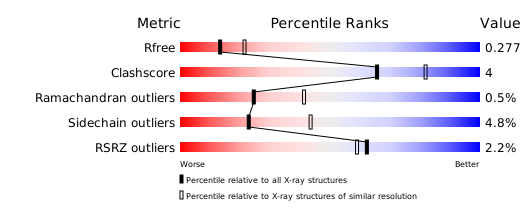
Download full validation report


