






 9LQD
9LQD
Crystal structure of SAM lyase
Summary for 9LQD
| Entry DOI | 10.2210/pdb9lqd/pdb |
| Descriptor | SAM lyase, D-MALATE (3 entities in total) |
| Functional Keywords | enzyme, sam, crispr-cas system, second messenger, immune system |
| Biological source | Clostridium botulinum (strain Hall / ATCC 3502 / NCTC 13319 / Type A) |
| Total number of polymer chains | 1 |
| Total formula weight | 14452.24 |
| Authors | |
| Primary citation | Duan, B.,Jin, X.,An, X.,Xiao, Y.,Yang, Q.,Zhao, H.,Huang, Y.,Wang, J.,Wang, Q.,Du, F.,Lu, L.,Sun, L.,Chen, Z.,Zhao, B. Molecular basis of SAM-AMP synthesis and degradation in the type III-B CRISPR-Cas system. Nat.Chem.Biol., 2025 Cited by PubMed Abstract: Upon sensing nonself target RNA, the CorA-associated type III-B CRISPR-Cas system catalyzes S-adenosyl methionine (SAM) and ATP to synthesize SAM-AMP, which activates the effector CorA and triggers immune responses. SAM-AMP can be degraded by NrN and SAM lyase, potentially deactivating the system. Here we find that the type III-B effector complex from Bacteroides fragilis uses a specific mechanism to recognize nonself target RNA and synthesize SAM-AMP. The 3' anti-tag of nonself target RNA induces conformational changes in the Cmr2 subunit, triggering SAM-AMP synthesis independently of the stalk loop of Cmr3 subunit. SAM-AMP binding induces NrN to transit from an open to a closed conformation, enabling hydrolysis of the 3'-5' phosphodiester bond. SAM lyase forms a triangular trimer that specifically degrades SAM-AMP into 5'-methylthioadenosine-AMP and homoserine lactone. These findings unveil unique mechanisms for SAM-AMP synthesis and degradation and provide deeper insights into the molecular basis of type III CRISPR-Cas signaling. PubMed: 41272318DOI: 10.1038/s41589-025-02075-z PDB entries with the same primary citation |
| Experimental method | X-RAY DIFFRACTION (2.16 Å) |
Structure validation
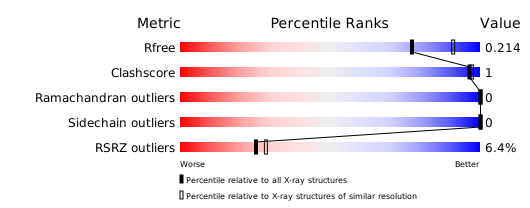
Download full validation report


