






 9LH3
9LH3
Vibrio cholerae cytolysin cradle loop mutant-Y194A half barrel pre-pore model
Summary for 9LH3
| Entry DOI | 10.2210/pdb9lh3/pdb |
| EMDB information | 63083 |
| Descriptor | Cytolysin VCC (1 entity in total) |
| Functional Keywords | membrane protein, heptameric half-barrel prepore, vcc mutant, pore-forming toxin, toxin |
| Biological source | Vibrio cholerae |
| Total number of polymer chains | 7 |
| Total formula weight | 451969.30 |
| Authors | Chattopadhyay, K.,Dutta, S.,Chatterjee, A.,Naskar, P.,Singh, M. (deposition date: 2025-01-11, release date: 2025-10-01, Last modification date: 2026-01-28) |
| Primary citation | Singh, M.,Chatterjee, A.,Nayak, A.,Naskar, P.,Kaur, G.,Mondal, J.,Dutta, S.,Chattopadhyay, K. Cradle loop regulates beta-barrel pore-formation mechanism of Vibrio cholerae cytolysin. Structure, 34:157-, 2026 Cited by PubMed Abstract: Vibrio cholerae cytolysin (VCC) is a β-barrel pore-forming toxin (β-PFT). The membrane insertion of its pore-forming "pre-stem" motif is the most crucial step in the pore-formation mechanism. In the soluble monomeric form, pre-stem remains clamped against the central cytolysin domain by the so-called cradle loop. In the course of oligomeric pore-formation in the target membranes, the cradle loop gets detached from the pre-stem and reorients, thus allowing the pre-stem to extend and insert into the membrane. Here, we show that the specific cradle loop residue(s) play crucial roles in governing the pore-formation mechanism of VCC by establishing decisive interactions with the neighboring structural domains/modules. The alteration of the cradle loop residue, Y194 in particular, compromises the membrane-insertion of the pre-stem, and tends to arrest the membrane-bound toxin in the pre-pore-like oligomeric states. Our study suggests that the native cradle loop architecture, with its intact contacts with the surrounding interaction partners, is essential for VCC pore-formation. PubMed: 41202807DOI: 10.1016/j.str.2025.10.013 PDB entries with the same primary citation |
| Experimental method | ELECTRON MICROSCOPY (3.51 Å) |
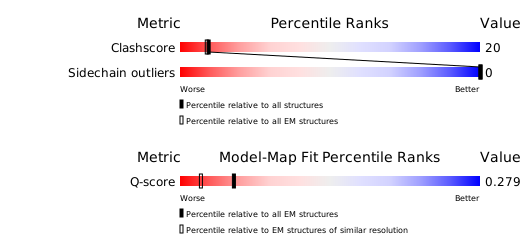
Structure validation
Download full validation report


