






 9LGF
9LGF
wild type bovine ABCC1 bound to two ATP molecules -2
Summary for 9LGF
| Entry DOI | 10.2210/pdb9lgf/pdb |
| EMDB information | 63064 |
| Descriptor | Multidrug resistance-associated protein 1, ADENOSINE-5'-TRIPHOSPHATE, MAGNESIUM ION (3 entities in total) |
| Functional Keywords | abc transporter, outward-open abcc1, protein transport |
| Biological source | Bos taurus (domestic cattle) |
| Total number of polymer chains | 1 |
| Total formula weight | 176067.66 |
| Authors | |
| Primary citation | Sun, P.,Liu, K.,Zhang, L.,Zhang, Q.,Gao, Y.,Li, Z.,Zhu, Y.,Liu, S.,Zhang, L.,Gao, A.,Gao, P. Substrate recognition diversity and transport dynamics of ABCC1. Nat Commun, 16:10499-10499, 2025 Cited by PubMed Abstract: ABCC1 is an ATP-binding cassette (ABC) transporter that exports diverse endogenous and exogenous substrates, conferring resistance to many anticancer drugs and mediating various physiological functions. Here, we present ten cryo-EM structures of ABCC1 in different functional states, providing systematic insights into its substrate recognition diversity and transport dynamics. ABCC1 utilizes a plastic bipartite substrate-binding pocket and a substrate-induced conformational flexibility to accommodate molecules with diverse properties, including bimolecular glutathione (GSH)-substrate pairs, GSH conjugates, and GSH-independent cyclic dinucleotides. A herein characterized substrate-releasing intermediate state reveals ATP-mediated overall conformational transitions and detailed pocket reorganization during substrate loading, pre-release, and post-release. Unexpectedly, we identify a sequential nucleotide release mechanism where the hydrolysis product ADP, rather than unhydrolyzed ATP, releases first, priming the transporter for turnover and resetting. Complemented by mutagenesis and functional assays, these findings provide a complete framework for understanding ABCC1's molecular basis and offer a foundation for developing next-generation modulators. PubMed: 41290683DOI: 10.1038/s41467-025-65501-9 PDB entries with the same primary citation |
| Experimental method | ELECTRON MICROSCOPY (3.01 Å) |
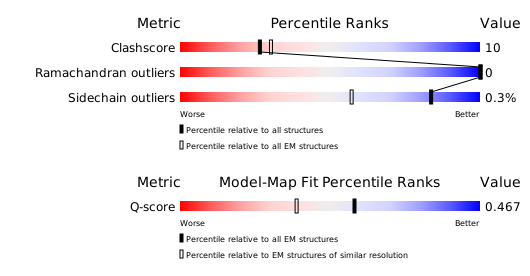
Structure validation
Download full validation report


