






 9LFT
9LFT
Biochemical and structural characterization of a novel 4-hydroxyphenylacetate-3-monooxygenase from Geobacillus mahadii Geo-05
Summary for 9LFT
| Entry DOI | 10.2210/pdb9lft/pdb |
| Descriptor | 4-Hydroxyphenylacetate-3-monooxygenase, 2,5,8,11,14,17,20,23,26,29,32,35,38,41,44,47,50,53,56,59,62,65,68,71,74,77,80-HEPTACOSAOXADOOCTACONTAN-82-OL (3 entities in total) |
| Functional Keywords | hydroxylation, two-component monooxygenases, thermophilic enzyme, flavoprotein, hydrolase |
| Biological source | Geobacillus mahadia |
| Total number of polymer chains | 4 |
| Total formula weight | 236440.62 |
| Authors | Che Husain, N.A.,Jamaluddin, H.,Jonet, M.A.,Padzil, A.M.,Taib, A.Z.M.,Zain, N.C.,Bakar, M.F.A.,Acharya, K.R.,Gregory, K.S. (deposition date: 2025-01-09, release date: 2025-09-10) |
| Primary citation | Che Husain, N.A.,Padzil, A.M.,Taib, A.Z.M.,Zain, N.C.,Bakar, M.F.A.,Gregory, K.S.,Acharya, K.R.,Jonet, M.A.,Jamaluddin, H. Biochemical and structural insights into GMHpaB: A thermostable 4-Hydroxyphenylacetate-3-monooxygenase with dual cofactor versatility. Int.J.Biol.Macromol., 321:146065-146065, 2025 Cited by PubMed Abstract: 4-Hydroxyphenylacetate-3-monooxygenase from the thermophilic bacterium Geobacillus mahadii Geo-05 catalyzes the hydroxylation of 4-hydroxyphenylacetate (4-HPA) to 3,4-dihydroxyphenylacetate (3,4-DHPA), marking the initial step of the 4-HPA degradation pathway. This enzyme comprises of two components: an oxygenase and reductase. In this study, the gene encoding the oxygenase component, GMHpaB was successfully cloned, overexpressed in Escherichia coli BL21 (DE3) and purified to homogeneity. Purified GMHpaB was shown to bind reduced chromogenic cofactors, evidenced by maximal absorbance peaks at 375 nm. GMHpaB is optimally active at 55 °C and demonstrates thermostability, retaining 96 % of its catalytic activity after 30 min of incubation at its optimum temperature. Furthermore, GMHpaB displays versatility, showing high enzymatic activity with both FMN and FAD as cofactors, with relative activity increases by 250 % and 383 %, respectively, compared to the cofactor-free control. The overall fold classifies GMHpaB as group D flavin-dependent monooxygenase, but distinct loop conformations set it apart from homologs within the group. Notably, residue Glu212, positioned on the substrate binding loop of GMHpaB plays a critical role in anchoring and stabilizing the flavin binding loop, potentially contributing to the enzymes dual cofactor compatibility. These biochemical and structural insights lay the groundwork for future applications, particularly in high-temperature biocatalysis. PubMed: 40683498DOI: 10.1016/j.ijbiomac.2025.146065 PDB entries with the same primary citation |
| Experimental method | X-RAY DIFFRACTION (2.4 Å) |
Structure validation
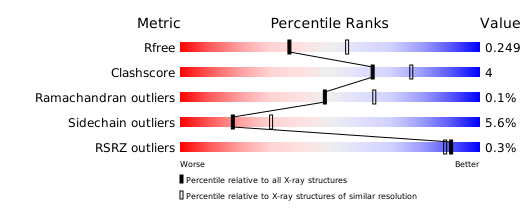
Download full validation report


