






 9LET
9LET
Cryo-EM structure of human ZAC in zinc Binding State
Summary for 9LET
| Entry DOI | 10.2210/pdb9let/pdb |
| EMDB information | 63033 |
| Descriptor | Ligand-gated cation channel ZACN,Genome polyprotein, beta-D-mannopyranose-(1-4)-2-acetamido-2-deoxy-beta-D-glucopyranose-(1-4)-2-acetamido-2-deoxy-beta-D-glucopyranose, ZINC ION (3 entities in total) |
| Functional Keywords | cys-loop receptor, homopentamer, cation channel, zinc-binding state, membrane protein |
| Biological source | Homo sapiens (human) More |
| Total number of polymer chains | 5 |
| Total formula weight | 400346.76 |
| Authors | |
| Primary citation | Zhou, Z.,Long, Y.,Chao, Y.,Yang, C.,Tang, Y.Q.,Shu, Y.,Zhu, H.,Jensen, A.A.,Qu, Q. Structural basis of human zinc-activated channel (ZAC) signaling and modulation. Cell Discov, 12:-, 2026 Cited by PubMed Abstract: Zinc (Zn) plays essential roles in a plethora of physiological processes, including key functions as a neuromodulator. The zinc-activated channel (ZAC) belongs to the Cys-loop receptor (CLR) superfamily of pentameric ligand-gated ion channels, which also comprises receptors for the important neurotransmitters acetylcholine, serotonin, GABA and glycine. In contrast to these classical CLRs, which have been extensively explored over decades, ZAC remains poorly characterized despite its potential significance in mammals. Here, we present several cryo-EM structures of human ZAC, including the ligand-free resting state, the Zn-bound state, and several antagonist-bound states. In the Zn-bound structure, Zn ions bind to the subunit interfaces of the extracellular domain, corresponding to the canonical agonist-binding sites in the classical CLRs, and are primarily coordinated through cation‒π interactions with two aromatic residues. While the antagonist TTFB inhibits ZAC by insertion between the transmembrane M2 helices of adjacent subunits, d-tubocurarine acts in a dual manner by blocking the channel and interfering with agonist binding. Combined with mutagenesis and electrophysiological analysis, these evaluations highlight the distinctive structural and functional features of this atypical CLR. PubMed: 41912481DOI: 10.1038/s41421-026-00878-5 PDB entries with the same primary citation |
| Experimental method | ELECTRON MICROSCOPY (2.62 Å) |
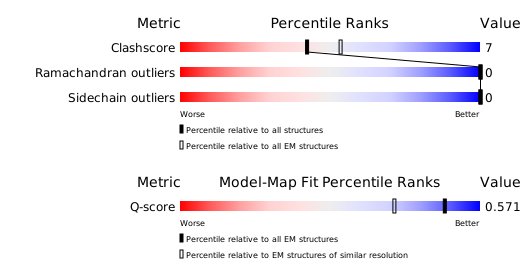
Structure validation
Download full validation report


