






 9LE4
9LE4
Crystal structure of the MIT-CD complex of STAMBP
Summary for 9LE4
| Entry DOI | 10.2210/pdb9le4/pdb |
| Descriptor | STAM-binding protein, 2-(N-MORPHOLINO)-ETHANESULFONIC ACID, ZINC ION, ... (5 entities in total) |
| Functional Keywords | stambp, deubiquitinase, autoinhibition, endocytosis |
| Biological source | Homo sapiens (human) More |
| Total number of polymer chains | 8 |
| Total formula weight | 152035.80 |
| Authors | |
| Primary citation | Chen, Z.,Wang, G.,Zhang, Y.,Ding, J. The MIT domain of STAMBP autoinhibits its deubiquitination activity. Structure, 33:1337-, 2025 Cited by PubMed Abstract: STAMBP, a member of the JAMM family of deubiquitinases, specifically targets K63-linked polyubiquitin chains and plays a vital role in regulating the endosomal sorting of activated cell surface receptors. In this study, we conducted comprehensive biochemical analyses of full-length STAMBP and several fragments and demonstrated that the MIT domain binds tightly to the catalytic domain (CD), resulting in autoinhibition of its activity. The crystal structure of the MIT-CD complex reveals that the MIT domain occupies a large portion of the distal ubiquitin-binding site of the CD domain, thereby obstructing substrate binding. Additionally, our biochemical data show that STAM1 binding to STAMBP facilitates substrate binding and enhances its activity, whereas binding of CHMP3 does not relieve autoinhibition or enhance activity. In summary, our findings reveal an autoinhibition mechanism of STAMBP via its MIT domain and provide further insights into the relationships between STAMBP, STAM, and CHMP in regulating STAMBP's activity. PubMed: 40441142DOI: 10.1016/j.str.2025.05.001 PDB entries with the same primary citation |
| Experimental method | X-RAY DIFFRACTION (2.6 Å) |
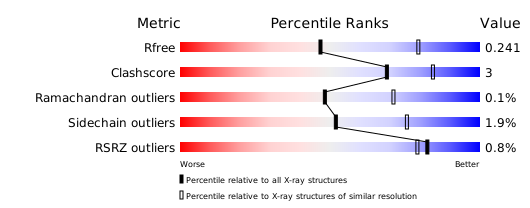
Structure validation
Download full validation report


