






 9L9D
9L9D
Bacillus subtilis endospore crust protein CgeA
Summary for 9L9D
| Entry DOI | 10.2210/pdb9l9d/pdb |
| EMDB information | 62902 |
| Descriptor | Spore crust protein CgeA (1 entity in total) |
| Functional Keywords | glycoprotein, sporulation, bacillus subtilis, structural protein |
| Biological source | Bacillus subtilis subsp. subtilis str. 168 |
| Total number of polymer chains | 6 |
| Total formula weight | 87020.50 |
| Authors | |
| Primary citation | Park, M.,Kim, D.,Baek, Y.,Jo, E.,Hyun, J.,Ha, N.C. Cryo-EM structure of the glycosylated protein CgeA in the crust of Bacillus subtilis endospores. J.Microbiol, 63:e2504013-e2504013, 2025 Cited by PubMed Abstract: The Bacillus subtilis spore crust is an exceptionally robust proteinaceous layer that protects spores under extreme environmental conditions. Among its key components, CgeA, a glycosylation-associated protein, plays a critical role in modifying crust properties through its glycosylated moiety, enhancing spore dispersal in aqueous environments. In this study, we present the high-resolution cryo-electron microscopy structure of the core region of CgeA at 3.05 Å resolution, revealing a doughnut-like hexameric assembly. The N-terminal regions are disordered, whereas the C-terminal region forms the core of the hexamer. Although the loop containing Thr112 was not resolved in the density map, its location can be inferred from surrounding residues, suggesting that Thr112 is situated on the exposed surface of the hexamer. On the opposite face, a distinct electrostatic pattern is observed, featuring a negatively charged central pore and a positively charged outer surface. Modeling and biochemical studies with the putative glycosyltransferase CgeB provide insights into how the glycosyl group is transferred to Thr112. This study offers a molecular-level understanding of the assembly, glycosylation, and environmental adaptability of the B. subtilis spore crust, with valuable implications for controlling spore formation in industrial applications. PubMed: 41164959DOI: 10.71150/jm.2504013 PDB entries with the same primary citation |
| Experimental method | ELECTRON MICROSCOPY (3.05 Å) |
Structure validation
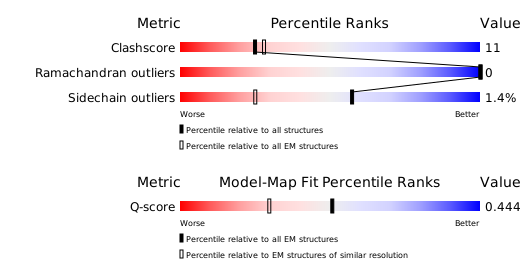
Download full validation report


