






 9L6D
9L6D
the crystal structure of Azurin-LBT
Summary for 9L6D
| Entry DOI | 10.2210/pdb9l6d/pdb |
| Descriptor | Azurin, COPPER (II) ION, TERBIUM(III) ION, ... (4 entities in total) |
| Functional Keywords | azurin, lanthanide-binding, electron transport |
| Biological source | Pseudomonas aeruginosa (strain ATCC 15692 / DSM 22644 / CIP 104116 / JCM 14847 / LMG 12228 / 1C / PRS 101 / PAO1) |
| Total number of polymer chains | 3 |
| Total formula weight | 49972.55 |
| Authors | |
| Primary citation | Su, B.,Yu, Y.,Liu, H.,Li, C. Engineering a Hetero-Bimetallic Azurin Photoenzyme for Photoredox Nitrite Reduction and SNO Adduct Formation. Chemistry, 31:e202500143-e202500143, 2025 Cited by PubMed Abstract: Photoredox catalysis in protein systems presents exciting opportunities to achieve sustainable and efficient enzymatic reactions driven by light. Here, we report the design and characterization of PhotoNiR, an engineered azurin-based protein incorporating a red copper center and a lanthanide-binding tag (LBT). This dual-metal system enables photoredox reduction of nitrite to nitric oxide via a proposed donor-f-electron-acceptor (D-f-A) electron transfer mechanism. Upon photoirradiation, aromatic residues in the LBT donate electrons to the lanthanide ion, which relays them to the Cu(II) center, reducing it to Cu(I). The reduced Cu(I)-PhotoNiR catalyzes the reduction of NO , and the generated NO subsequently reacts with free cysteine residues to form S-nitrosothiol (SNO) species. Spectroscopic and structural characterization confirmed that the copper center retains the properties of a red copper site and that the lanthanide-binding tag supports efficient electron transfer. This work represents one of the first examples of a D-f-A mechanism in a protein system, demonstrating the potential of integrating metalloprotein engineering with lanthanide photochemistry to develop novel photoenzymes for light-driven catalysis. PubMed: 40038049DOI: 10.1002/chem.202500143 PDB entries with the same primary citation |
| Experimental method | X-RAY DIFFRACTION (2.38 Å) |
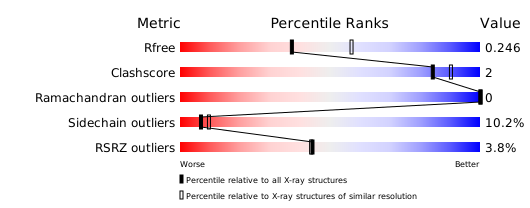
Structure validation
Download full validation report


