






 9L5M
9L5M
X-ray structure of sarcoplasmic Ca-binding protein (SCP), a calcium ion-binding protein from Pinctada fucata
Summary for 9L5M
| Entry DOI | 10.2210/pdb9l5m/pdb |
| Descriptor | Sarcoplasmic Ca-binding protein (SCP), CALCIUM ION (3 entities in total) |
| Functional Keywords | ef-hand, calcium-binding, sarcoplasmic, metal binding protein |
| Biological source | Pinctada fucata |
| Total number of polymer chains | 3 |
| Total formula weight | 62912.05 |
| Authors | Namikawa, Y.,Zhu, L.,Wang, L.,Lu, P.,Zhang, M.,Nagata, K.,Suzuki, M. (deposition date: 2024-12-23, release date: 2025-11-05) |
| Primary citation | Namikawa, Y.,Zhu, L.,Lu, P.,Nagata, K.,Suzuki, M. Calcium dissociation with carbonate ions from Pf-SCP, sarcoplasmic calcium-binding protein in Pinctada fucata, contributes to calcium mineralization for shell formation. Protein Sci., 34:e70336-e70336, 2025 Cited by PubMed Abstract: Pf-SCP is an EF-hand protein identified in Pinctada fucata that is responsible for calcium transport and concentration in the mantle for shell formation. Previous studies have reported the calcium-binding properties of the EF-hand domains and the localization of Pf-SCP. To understand the calcification from Pf-SCP as a source of calcium, the dissociation of calcium from Pf-SCP must be investigated. However, calcium dissociation from EF-hand proteins, particularly in the presence of carbonate ions, remains poorly understood. In this study, we demonstrated that calcium dissociation from Pf-SCP was induced by carbonate ions using the fluorescence spectra of Pf-SCP, and this was followed by the synthesis of calcium carbonate that was characterized using scanning electron microscope-energy dispersive X-ray spectrometry (SEM-EDS). To gain insight into the calcium dissociation of Pf-SCP at the atomic level, we conducted molecular dynamics simulations using a multi-state ion model for calcium ions. The proposed mechanism of calcium dissociation in Pf-SCP is as follows: Water molecules first replace the amino acids in the EF-hand domain to coordinate calcium ions. Next, the carbonate ions bind to the calcium ions, decreasing the binding affinity of the EF-hand domains for the calcium ions. Finally, the calcium ions detach from the EF-hand, forming a complex with water molecules and carbonate ions. These findings provide a detailed understanding of the structural dynamics of calcium dissociation and the biomineralization mechanism in P. fucata, particularly in relation to the mantle calcification process. PubMed: 41123418DOI: 10.1002/pro.70336 PDB entries with the same primary citation |
| Experimental method | X-RAY DIFFRACTION (2 Å) |
Structure validation
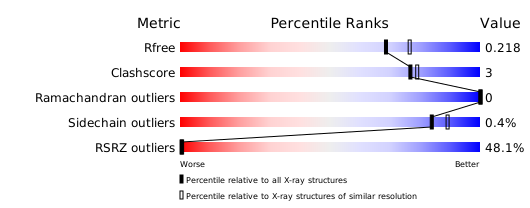
Download full validation report


