






 9L2Q
9L2Q
Crystal structure of anti-CRISPR protein AcrIE7
Summary for 9L2Q
| Entry DOI | 10.2210/pdb9l2q/pdb |
| Descriptor | H2C2 (2 entities in total) |
| Functional Keywords | hypothetical antiviral protein, antiviral protein |
| Biological source | Streptococcus macedonicus |
| Total number of polymer chains | 3 |
| Total formula weight | 36043.82 |
| Authors | |
| Primary citation | Liu, Z.,Liu, Y.,Zhang, S.,Wen, Y.,Wang, X.,Han, J.,Yin, H. Crystal structure of the anti-CRISPR protein AcrIE7. Biochem.Biophys.Res.Commun., 748:151315-151315, 2025 Cited by PubMed Abstract: Bacterial adaptive immunity, driven by CRISPR-Cas systems, protects against foreign nucleic acids from mobile genetic elements (MGEs), like bacteriophages. The type I-E CRISPR-Cas system employs the Cascade (CRISPR-associated complex for antiviral defense) complex for target DNA cleavage, guided by crRNA. Anti-CRISPR (Acr) proteins, such as AcrIE7, counteract this defense by inhibiting Cascade activity. In this study, we characterized and determined the structure of AcrIE7, a unique member of the AcrIE family, using X-ray crystallography under two distinct crystallization conditions, achieving resolutions of 2.05 Å and 2.68 Å, respectively. Topological analysis revealed that AcrIE7 consists of seven α-helices with two distinct charge regions, likely mediating its inhibitory interactions. Structural flexibility analysis revealed notable structural stability differences between the two crystallization conditions, indicating varying rigidity of the AcrIE7 protein under different conditions. Homology searches and AlphaFold predictions reinforced the unique nature of AcrIE7, which exhibits a novel fold, underscoring its distinct role within the AcrIE family. These findings enhance our understanding of Acr proteins and provide a theoretical foundation for developing CRISPR-based gene-editing regulatory tools. PubMed: 39818188DOI: 10.1016/j.bbrc.2025.151315 PDB entries with the same primary citation |
| Experimental method | X-RAY DIFFRACTION (2.054 Å) |
Structure validation
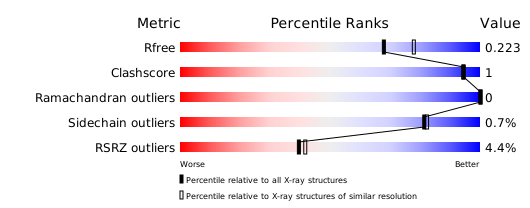
Download full validation report


