






 9KZ6
9KZ6
The cryo-EM structure of porcine serum MGAM
Summary for 9KZ6
| Entry DOI | 10.2210/pdb9kz6/pdb |
| EMDB information | 62652 |
| Descriptor | Maltase-glucoamylase, 2-acetamido-2-deoxy-beta-D-glucopyranose-(1-4)-2-acetamido-2-deoxy-beta-D-glucopyranose, 2-acetamido-2-deoxy-beta-D-glucopyranose-(1-4)-[alpha-L-fucopyranose-(1-6)]2-acetamido-2-deoxy-beta-D-glucopyranose, ... (4 entities in total) |
| Functional Keywords | alpha-glucosidase, hydrolase |
| Biological source | Sus scrofa domesticus (domestic pig) |
| Total number of polymer chains | 1 |
| Total formula weight | 208545.49 |
| Authors | Tagami, T.,Kawasaki, M.,Adachi, N. (deposition date: 2024-12-10, release date: 2025-12-10, Last modification date: 2026-01-28) |
| Primary citation | Watanabe, K.,Tagami, T.,Biwa, C.,Kawasaki, M.,Adachi, N.,Moriya, T.,Senda, T.,Okuyama, M. Porcine serum maltase-glucoamylase: structure, kinetics, and inhibition. J Enzyme Inhib Med Chem, 41:2612391-2612391, 2026 Cited by PubMed Abstract: Maltase-glucoamylase (MGAM) is a small-intestinal enzyme comprising two tandem α-glucosidase units, NtMGAM and CtMGAM, each capable of hydrolysing maltodextrins into glucose. MGAM serves as a therapeutic target for managing postprandial hyperglycaemia; comprehensive insights into its full-length three-dimensional structure and inhibitor kinetics remains limited. Here, we demonstrate that the α-glucosidase in porcine serum is comparable to that encoded by the MGAM gene. Using cryo-electron microscopy, we determined the complex structure of serum MGAM with the inhibitor acarviosyl-maltotriose (AC5), which was found to bind exclusively to the active sites of each unit, confirming the presence of independent catalytic sites. AC5 was shown to exhibit mixed-type inhibition towards full-length serum MGAM and competitive inhibition against both recombinant NtMGAM and CtMGAM. The apparent mixed-type inhibition can be more accurately attributed to dual competitive inhibition mechanisms. These findings contribute to the advancement of functional foods and therapeutic interventions for postprandial hyperglycaemia and type 2 diabetes. PubMed: 41534875DOI: 10.1080/14756366.2025.2612391 PDB entries with the same primary citation |
| Experimental method | ELECTRON MICROSCOPY (3.17 Å) |
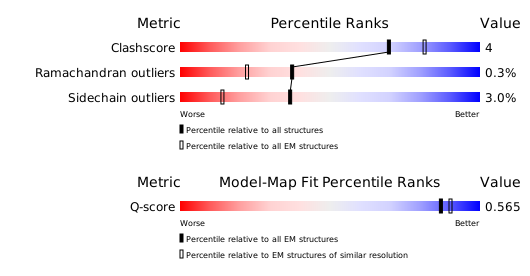
Structure validation
Download full validation report


