






 9KVW
9KVWSummary for 9KVW
| Entry DOI | 10.2210/pdb9kvw/pdb |
| Descriptor | Kelch-like ECH-associated protein 1, ~{N}-[4-[(2-azanyl-2-oxidanylidene-ethyl)-[4-[(2-azanyl-2-oxidanylidene-ethyl)-(4-methoxyphenyl)sulfonyl-amino]naphthalen-1-yl]sulfamoyl]phenyl]-3-(2-oxa-8-azaspiro[4.5]decan-8-yl)propanamide (3 entities in total) |
| Functional Keywords | complex, inhibitor, protein binding |
| Biological source | Homo sapiens (human) |
| Total number of polymer chains | 1 |
| Total formula weight | 32376.22 |
| Authors | Zhuang, C.L.,Yu, R.L. (deposition date: 2024-12-05, release date: 2025-12-10, Last modification date: 2026-06-24) |
| Primary citation | Chen, Y.,Qin, Q.,Ding, W.,Yu, R.,Wang, R.,Ji, H.,Yan, J.,Ma, H.,Jiang, C.S.,Sun, Y.,Zhuang, C. Design of spiro-heterocyclic substituted diaminonaphthalene Keap1-Nrf2 protein-protein interaction inhibitors as novel anti-depressant agents. Eur.J.Med.Chem., 296:117848-117848, 2025 Cited by PubMed Abstract: Oxidative stress, inflammation and the Keap1-Nrf2 pathway are validated to be related to depression. Theoretically, modulating Keap1 and Nrf2 protein-protein interaction (PPI) should be an effective method to activate Nrf2 for the treatment of major depressive disorders. We previously reported NXPZ-2, a 1,4-diaminonaphthalene, as a Keap1-Nrf2 PPI inhibitor that exhibited promising effects in an Alzheimer's disease (AD) mouse model. However, its pharmacokinetic properties were limited. Herein, we, for the first time, developed a series of heterocyclic substituted diaminonaphthalenes by an "Escape from Flatland" strategy to improve sp hybridized carbons. These compounds exhibited strong binding affinity for Keap1. A crystallographic analysis revealed the high-resolution (1.44 Å) binding of CD-10 with the Keap1 protein, elucidating the complexity of CD-10's binding mechanism. In an LPS-stimulated BV2 cell model, CD-10 demonstrated the best anti-oxidative stress and anti-inflammatory potential. Furthermore, CD-10's ability to penetrate the blood-brain barrier has been significantly improved. In a chronic unpredictable mild stress (CUMS) mouse model, treatment with CD-10 effectively alleviated anxiety and depressive behaviors and restored serum neurotransmitter levels by promoting Nrf2 nuclear translocation. Overall, our findings validate that the Keap1-Nrf2 PPI inhibitor holds promise as a preclinical candidate for the treatment of depression. PubMed: 40513368DOI: 10.1016/j.ejmech.2025.117848 PDB entries with the same primary citation |
| Experimental method | X-RAY DIFFRACTION (1.44 Å) |
Structure validation
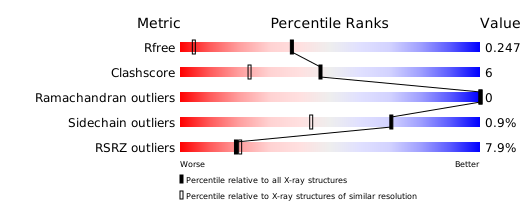
Download full validation report


