






 9KUE
9KUE
Crystal structure of the soluble green pigment protein from Tettigonia cantans
This is a non-PDB format compatible entry.
Summary for 9KUE
| Entry DOI | 10.2210/pdb9kue/pdb |
| Descriptor | Dibilinoxanthinin (DBXN), (3R,3'R,6S)-4,5-DIDEHYDRO-5,6-DIHYDRO-BETA,BETA-CAROTENE-3,3'-DIOL, AZIDE ION, ... (8 entities in total) |
| Functional Keywords | carotenoid binding, bilin binding, carotenoid carrier, transport protein, vitellogenin, bichromoprotein |
| Biological source | Tettigonia cantans More |
| Total number of polymer chains | 6 |
| Total formula weight | 82871.25 |
| Authors | Sluchanko, N.N.,Egorkin, N.A.,Varfolomeeva, L.A.,Popov, V.O.,Boyko, K.M. (deposition date: 2024-12-03, release date: 2025-04-23, Last modification date: 2025-09-10) |
| Primary citation | Egorkin, N.A.,Aleksin, A.M.,Sedlov, I.A.,Zhiganov, N.I.,Bodunova, D.V.,Varfolomeeva, L.A.,Slonimskiy, Y.B.,Ziganshin, R.H.,Popov, V.O.,Boyko, K.M.,Vassilevski, A.A.,Maksimov, E.G.,Sluchanko, N.N. A green dichromophoric protein enabling foliage mimicry in arthropods. Proc.Natl.Acad.Sci.USA, 122:e2502567122-e2502567122, 2025 Cited by PubMed Abstract: Molecular mechanisms underlying the green insect camouflage have puzzled researchers for over a century. Here, we isolated and identified a green water-soluble protein from the integument of bush-cricket . De novo sequencing and cloning revealed a severely fragmented form of vitellogenins, ubiquitous and multifunctional, but still largely enigmatic glycolipoproteins essential for embryonic development and lacking structural characterization. The distinctive color of the identified chromoprotein results from binding of a remarkable combination of farnesylated bilins (recently identified, tentative heme A catabolites) and xanthophylls, which commensurably absorb light in the 600 to 700 nm and 400 to 550 nm spectral regions and thereby produce a hue that perfectly mimics foliage. The high-resolution crystal structure of this unique ~80 kDa dichromophoric protein, which we named "dibilinoxanthinin" (DBXN), revealed two DBXN protomers, each consisting of three polypeptides, with a novel fold enclosing a large hydrophobic cavity that accommodates two bilins, two luteins, and four phosphatidylcholines, all anchored by hydrogen bonds and giving DBXN unique biochemical and optical properties. Among the green insects tested, some contained yellow and blue chromophores in separate fractions, while others had green proteins similar to DBXN, although not necessarily of the same size. Surprisingly, we isolated and identified a larger vitellogenin proteoform with DBXN-like absorption, from the green huntsman spider . These data illustrate striking variations in the DBXN-related pigmentation mechanism among different green arthropods and suggest that vitellogenins may have undergone neofunctionalization, reflecting their potential for functional diversification. PubMed: 40424164DOI: 10.1073/pnas.2502567122 PDB entries with the same primary citation |
| Experimental method | X-RAY DIFFRACTION (1.99 Å) |
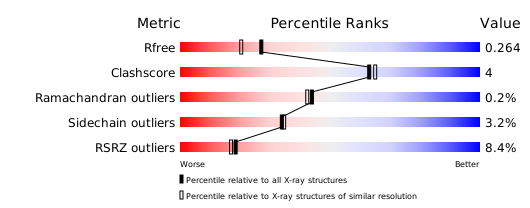
Structure validation
Download full validation report


