






 9KTW
9KTW
Cryo-EM structure of wild type RIG-I with 5'p-RNA
Summary for 9KTW
| Entry DOI | 10.2210/pdb9ktw/pdb |
| EMDB information | 62568 |
| Descriptor | Antiviral innate immune response receptor RIG-I, 5'p-RNA (60-MER), ZINC ION (3 entities in total) |
| Functional Keywords | rna recognition, atp hydrolysis, rlr signaling, immune system |
| Biological source | Homo sapiens (human) More |
| Total number of polymer chains | 2 |
| Total formula weight | 126048.38 |
| Authors | |
| Primary citation | Satoh, S.,Tan, Y.B.,Heil, B.,Yamada, S.,Schutte, V.,Phang, C.,Tang, C.,Tsukamoto, Y.,Higuchi, T.,Fujita, T.,Behrendt, R.,Schlee, M.,Luo, D.,Kato, H. Local activation of mutant RIG-I by short noncoding Y-RNA in the kidney triggers lethal nephritis. Sci Immunol, 10:eadx1135-eadx1135, 2025 Cited by PubMed Abstract: Detecting viral RNA by the ubiquitously expressed cytosolic receptor retinoic acid-inducible gene I (RIG-I) is critical for antiviral immune responses, including type I interferon (IFN-I) and chemokine induction. RIG-I has evolved to sensitively recognize viral RNA but tolerate self-RNA. RIG-I mutations causing self-tolerance loss induce IFN-I and chemokines in patients, initiating autoinflammation. We observed that mice expressing the RIG-I patient variant E373A spontaneously developed lupus-like nephritis. Kidney-derived chemokines attracted monocytes through CCR2 (C-C motif chemokine receptor 2) and induced interstitial inflammation and tubular damage. This led to renal dysfunction independently of immunoglobulin G-nucleic acid complex deposition. Sequencing of RIG-I E373A-bound RNA from kidney-derived cells identified short noncoding Y-RNA. Deletion of the most enriched Y-RNA species reduced RIG-I E373A-induced IFN-I responses. Cryo-electron microscopy and molecular analyses revealed that RIG-I E373A binding to the Y-RNA stem region resulted in its activation. Thus, we demonstrate that Y-RNA activates a RIG-I gain-of-function mutant in a tissue-specific manner, causing autoinflammation culminating in lupus nephritis. PubMed: 41171879DOI: 10.1126/sciimmunol.adx1135 PDB entries with the same primary citation |
| Experimental method | ELECTRON MICROSCOPY (2.6 Å) |
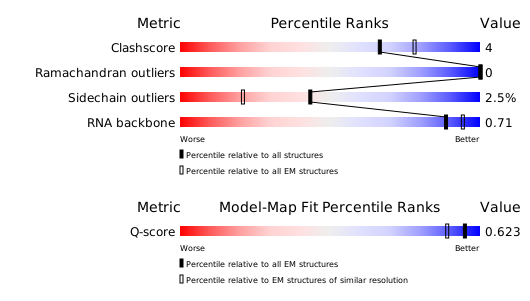
Structure validation
Download full validation report


