






 9KT8
9KT8
Cryo-EM structure of HCA2-Gi complex with acifran
Summary for 9KT8
| Entry DOI | 10.2210/pdb9kt8/pdb |
| EMDB information | 62559 |
| Descriptor | Guanine nucleotide-binding protein G(i) subunit alpha-1, Guanine nucleotide-binding protein G(I)/G(S)/G(T) subunit beta-1, Guanine nucleotide-binding protein G(I)/G(S)/G(O) subunit gamma-2, ... (6 entities in total) |
| Functional Keywords | cryo-em; g-protein-coupled receptors; hydroxycarboxylic acid receptors, signaling protein/immune system, signaling protein-immune system complex |
| Biological source | Homo sapiens (human) More |
| Total number of polymer chains | 5 |
| Total formula weight | 156489.73 |
| Authors | |
| Primary citation | Wang, J.,Qian, Y.,Han, Z.,Wang, Y.,Liu, Y.,Li, J.,Duanmu, Q.,Ye, S.,Qiao, A.,Wu, S. Insights into the Activation Mechanism of HCA1, HCA2, and HCA3. J.Med.Chem., 68:4527-4539, 2025 Cited by PubMed Abstract: Hydroxy-carboxylic acid receptors HCA1, HCA2, and HCA3 can be activated by important intermediates of energy metabolism. Despite the research focusing on HCA2, its clinical application has been limited by adverse effects. Therefore, the role of HCA1 as a promising target for the treatment of lipolysis warrants further exploration. As HCAs exhibit high similarity when activated with diverse selective agonists, a conserved yet unique activation mechanism for HCAs remains undisclosed. Herein, we unveil the cryo-electron microscopy structures of the 3,5-DHBA-HCA1-Gi signaling complex, the acifran- and MK6892-bound HCA2-Gi signaling complexes, and the acifran-HCA3-Gi signaling complex. Comparative analysis across HCAs reveals key residues in HCA1 contributing to the stabilization of the ligand-binding pocket. Furthermore, chimeric complexes and mutational analyses identify residues that are pivotal for HCA2 and HCA3 selectivity. Our findings elucidate critical structural insights into the mechanisms of ligand recognition and activation within HCA1 and broaden our comprehension of ligand specificity binding across the HCA family. PubMed: 39936872DOI: 10.1021/acs.jmedchem.4c02567 PDB entries with the same primary citation |
| Experimental method | ELECTRON MICROSCOPY (2.73 Å) |
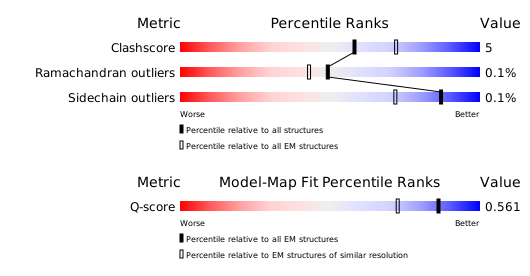
Structure validation
Download full validation report


