






 9KRP
9KRP
Structure of the HCV IRES-dependent 48S translation initiation complex with eIF5B and eIF3
This is a non-PDB format compatible entry.
Summary for 9KRP
| Entry DOI | 10.2210/pdb9krp/pdb |
| Related | 9KKF 9KN5 9KN6 9KZU 9KZX |
| EMDB information | 62535 |
| Descriptor | Small ribosomal subunit protein uS2, 40S ribosomal protein S9, 40S ribosomal protein S10, ... (50 entities in total) |
| Functional Keywords | hcv ires, ribosome |
| Biological source | Homo sapiens (human) More |
| Total number of polymer chains | 47 |
| Total formula weight | 2028425.34 |
| Authors | Iwasaki, W.,Kashiwagi, K.,Sakamoto, A.,Nishimoto, M.,Takahashi, M.,Machida, K.,Imataka, H.,Matsumoto, A.,Shichino, Y.,Iwasaki, S.,Imami, K.,Ito, T. (deposition date: 2024-11-28, release date: 2025-12-03, Last modification date: 2025-12-17) |
| Primary citation | Iwasaki, W.,Kashiwagi, K.,Sakamoto, A.,Nishimoto, M.,Takahashi, M.,Machida, K.,Imataka, H.,Matsumoto, A.,Shichino, Y.,Iwasaki, S.,Imami, K.,Ito, T. Structural insights into the role of eIF3 in translation mediated by the HCV IRES. Proc.Natl.Acad.Sci.USA, 122:e2505538122-e2505538122, 2025 Cited by PubMed Abstract: The genomes of various RNA viruses and a subset of human genes contain structured RNA elements termed internal ribosomal entry sites (IRESs) to initiate translation in a cap-independent manner. The well-studied IRES from Hepatitis C virus (HCV) binds to eukaryotic initiation factor 3 (eIF3), but how the HCV IRES harnesses eIF3 for viral translation remains unclear. Here, we determined multiple cryo-EM structures in which the HCV IRES binds simultaneously to the ribosome and eIF3, covering steps from initiation to elongation. The eIF3 core subunits are displaced from the ribosome by binding more tightly to subdomain IIIb of the HCV IRES. However, cross-linking mass spectrometry suggested that the eIF3 noncore subunits in the HCV-IRES-mediated elongation complex remain in similar positions on the ribosome to those observed in the cap-mediated initiation complex. This currently determined configuration of eIF3 core and noncore subunits reveals the mechanisms through which the HCV IRES overcomes the competition with the host mRNA and promotes viral mRNA translation by utilizing eIF3. Interestingly, cryo-EM structures also revealed that the N-terminal domain of the eIF3 c-subunit (eIF3c-NTD) binds to the large ribosomal subunit (60S) during elongation. These findings suggest that eIF3 contributes to HCV IRES-mediated translation not only during initiation but also elongation and potentially in reinitiation. The interaction between the eIF3c-NTD and the 60S ribosome is likely to occur in general translation processes as well, contributing to 60S joining or eIF3 stabilization on the elongating ribosome. PubMed: 41337487DOI: 10.1073/pnas.2505538122 PDB entries with the same primary citation |
| Experimental method | ELECTRON MICROSCOPY (3.2 Å) |
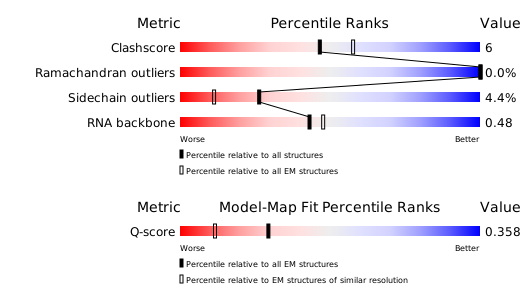
Structure validation
Download full validation report


