






 9KLK
9KLK
Strigolactone-induced ASK1-MAX2-HTL7-SMAX1 complex (Class 4) with covalently bound D-ring
Summary for 9KLK
| Entry DOI | 10.2210/pdb9klk/pdb |
| EMDB information | 62397 62407 |
| Descriptor | SKP1-like protein 1A, Hyposensitive to light 7, F-box protein, ... (4 entities in total) |
| Functional Keywords | strigolactone, scf, ubiquitination, signaling protein |
| Biological source | Arabidopsis thaliana (thale cress) More |
| Total number of polymer chains | 3 |
| Total formula weight | 137272.87 |
| Authors | Vancea, A.I.,Huntington, B.,Savva, C.G.,Arold, S.T. (deposition date: 2024-11-14, release date: 2025-09-17, Last modification date: 2025-12-03) |
| Primary citation | Vancea, A.I.,Huntington, B.,Steinchen, W.,Savva, C.G.,Shahul Hameed, U.F.,Arold, S.T. Mechanism of cooperative strigolactone perception by the MAX2 ubiquitin ligase-receptor-substrate complex. Nat Commun, 16:10291-10291, 2025 Cited by PubMed Abstract: Strigolactones are plant hormones that regulate development and mediate interactions with soil organisms, including the germination of parasitic plants such as Striga hermonthica. Strigolactone perception by receptors initiates the degradation of transcriptional repressors via E3 ubiquitin ligases, but the mechanistic link between hormone binding and substrate ubiquitination has remained unclear. We determine cryogenic electron microscopy structures of the receptor-ligase-substrate complex, composed of Arabidopsis ASK1 and substrate, and Striga F-box and receptor proteins. Strigolactone hydrolysis by the receptor, which covalently retains the D-ring, is a prerequisite for complex formation. The substrate engages the complex through two domains, forming a dynamic interface that stabilises the receptor-ligase assembly and repositions the ASK1, suggesting a mechanism for efficient ubiquitination. Here, we show how dynamic, multivalent interactions within the receptor-ligase-substrate complex translate hormone perception into targeted protein degradation, providing insight into how plants integrate hormonal signals into developmental decisions. PubMed: 41271672DOI: 10.1038/s41467-025-65205-0 PDB entries with the same primary citation |
| Experimental method | ELECTRON MICROSCOPY (2.9 Å) |
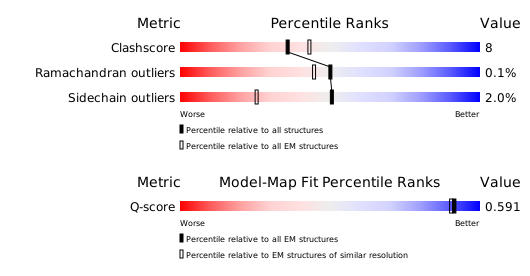
Structure validation
Download full validation report


