






 9KKT
9KKT
Structure-guided interface engineering for modifying substrate binding and catalytic activity of 2-keto-3-deoxy-D-xylonate dehydratase
Summary for 9KKT
| Entry DOI | 10.2210/pdb9kkt/pdb |
| Descriptor | Fumarylacetoacetate hydrolase family protein, MAGNESIUM ION, 2-AMINO-2-HYDROXYMETHYL-PROPANE-1,3-DIOL, ... (5 entities in total) |
| Functional Keywords | apo, carbohydrate |
| Biological source | Caulobacter vibrioides NA1000 (Caulobacter crescentus) |
| Total number of polymer chains | 2 |
| Total formula weight | 82634.05 |
| Authors | Liang, B. (deposition date: 2024-11-14, release date: 2025-11-19, Last modification date: 2026-06-03) |
| Primary citation | Liang, B.,Meng, C.,Wang, Q.,Du, Y.,Luo, Y.,Zhao, J.,Wu, D.,Liang, Y.,Lu, X.,Yang, J. Structure-Guided Subunit Interface Engineering to Improve the Catalytic Efficiency of Dimeric Enzymes of FAH Family. J.Agric.Food Chem., 73:32094-32106, 2025 Cited by PubMed Abstract: The subunit interface plays a substantial role in the structures and functions of oligomeric enzymes, yet targeted mutations remain difficult to predict. Here, we targeted 2-keto-3-deoxy-d-xylonate dehydratase (XylX), the rate-limiting catalyst in the Weimberg pathway for d-xylose catabolism and a member of the fumarylacetoacetate hydrolase (FAH) family, which forms a compact homodimer. Guided by its crystal structure, we engineered the dimer interface and obtained triple mutant L210A/P181Q/Q308A, which showed a 6.04-fold increase in catalytic efficiency. Molecular dynamics simulations revealed that moderate enhancement of intersubunit flexibility accelerates substrate binding. When the mutant was coupled with other Weimberg enzymes in a one-pot process, 77% of d-xylose was converted to 56.05 ± 0.39 g/L α-ketoglutaric acid within 6 h. Moreover, this strategy is also applicable to other dimeric enzymes within the FAH family. This study highlights a promising strategy for engineering dimeric enzymes with a higher catalytic efficiency for producing valuable chemicals. PubMed: 41339057DOI: 10.1021/acs.jafc.5c09893 PDB entries with the same primary citation |
| Experimental method | X-RAY DIFFRACTION (2.01 Å) |
Structure validation
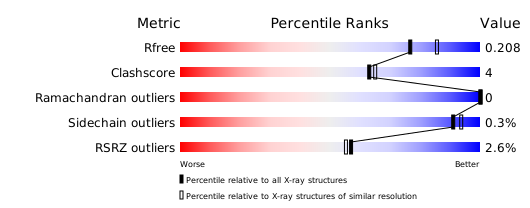
Download full validation report


