






 9KKB
9KKB
Cryo-EM Structure of CdnG-E2 complex with GTP from Serratia marcescens
Summary for 9KKB
| Entry DOI | 10.2210/pdb9kkb/pdb |
| EMDB information | 62384 |
| Descriptor | CdnG, E2, GUANOSINE-5'-TRIPHOSPHATE (3 entities in total) |
| Functional Keywords | cgas, cdng, e2, cbass, antiviral protein |
| Biological source | Serratia marcescens More |
| Total number of polymer chains | 2 |
| Total formula weight | 64787.56 |
| Authors | |
| Primary citation | Xiao, J.,Yan, Y.,Li, J.,Oyejobi, G.K.,Lan, D.,Zhu, B.,Wang, Z.,Wang, L. Structures and mechanism of E2-CBASS anti-phage system. Mlife, 5:99-107, 2026 Cited by PubMed Abstract: Bacteria deploy diverse innate immune systems to combat bacteriophage infections. The cyclic-oligonucleotide-based anti-phage signaling system (CBASS) is a type of innate prokaryotic immune system. CBASS synthesizes cyclic-oligonucleotide through cGAS/DncV-like nucleotidyltransferases (CD-NTases) to activate downstream effectors, which kill bacteriophage-infected bacteria, thereby stopping phage spread. One major class of CBASS contains a homolog of eukaryotic ubiquitin-conjugating enzymes, either as an E1-E2 fusion or a single E2 enzyme. Both enzymes function by regulating CD-NTase activity. Currently, many structures of CD-NTases have been reported, but there are only a few reports of structures where CD-NTases form complexes with the associated E2. In this study, we analyzed the length and classification of the CD-NTase in two types of type II CBASS-E1E2/JAB-CBASS and E2-CBASS. We found that the CD-NTase in E2-CBASS is longer and predominantly belongs to clade G. We also present the structure of the CdnG-E2 complex with the bound GTP substrate, which indicates the conservation of the donor binding pattern. Interestingly, we discovered that CdnG contains a conserved C-terminal α-helix and β-sheet structure, which is uniquely involved in forming a complex with E2. We also found that the structure of the E2 protein in the E2-CBASS system is highly conserved. Altogether, we provide mechanistic insights into the E2-CBASS system. PubMed: 41767953DOI: 10.1002/mlf2.70052 PDB entries with the same primary citation |
| Experimental method | ELECTRON MICROSCOPY (3.36 Å) |
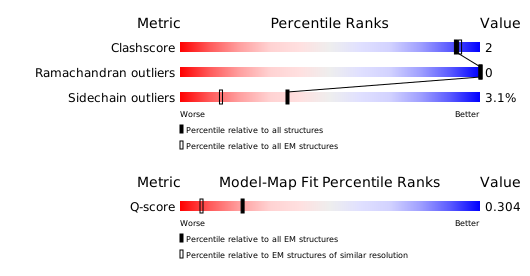
Structure validation
Download full validation report


