






 9KDO
9KDO
The structure of 2 ACTD bound to RNA polymerase II elongation complex with 3 CTG repeats
This is a non-PDB format compatible entry.
Summary for 9KDO
| Entry DOI | 10.2210/pdb9kdo/pdb |
| EMDB information | 62148 62264 62265 62266 62282 62283 62284 |
| Related PRD ID | PRD_000001 |
| Descriptor | DNA-directed RNA polymerase II subunit RPB1, DNA-directed RNA polymerases I, II, and III subunit RPABC5, DNA-directed RNA polymerase II subunit RPB11, ... (18 entities in total) |
| Functional Keywords | rna polymerase ii elongation complex, actinomycin d, transcription, ctg repeat |
| Biological source | Saccharomyces cerevisiae S288C More |
| Total number of polymer chains | 17 |
| Total formula weight | 551155.35 |
| Authors | |
| Primary citation | Zhao, W.,Zhu, L.,Liu, Y.,Deng, W.,Yang, X.,Ye, L.,Lin, Z.,Ding, K.,Yang, X.,Li, X.,Xu, J. Stepwise transcription stalling by the anti-cancer drug Actinomycin D and insights into short tandem repeat transcription inhibition. Nat Commun, 17:-, 2026 Cited by PubMed Abstract: Short tandem repeats (STRs) comprise 6% of the human genome, and their transcription is linked to over 60 diseases. Actinomycin D (ACTD) is the first clinically approved anticancer antibiotic that inhibits transcription through an incompletely understood mechanism. Here, using reconstituted yeast and mammalian systems, we investigate the mechanism of transcription inhibition and examine the impact of ACTD on STR transcription. We show that ACTD induces RNA polymerase II (Pol II) pausing at three distinct states and present structural snapshots of Pol II processing ACTD in these states. Furthermore, we examine ACTD's effects on Pol II transcribing five disease-linked, GC-rich STRs and resolve structures of Pol II in complex with ACTD during the transcription of CTG repeats associated with myotonic dystrophy type 1. Our findings reveal the structural basis of ACTD-mediated transcription inhibition and provide a framework for the rational modification of ACTD to target STR-associated disorders. PubMed: 41833943DOI: 10.1038/s41467-026-70612-y PDB entries with the same primary citation |
| Experimental method | ELECTRON MICROSCOPY (2.92 Å) |
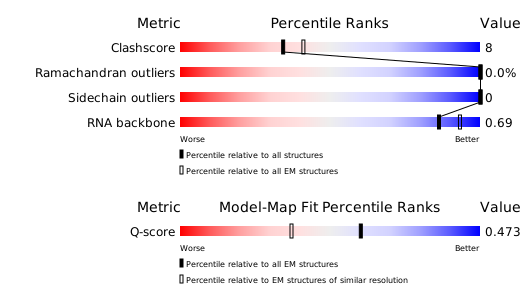
Structure validation
Download full validation report


