






 9KCE
9KCE
Crystal Structure of the ATP analog-bound closed state of Thermotoga maritima MutS2
Summary for 9KCE
| Entry DOI | 10.2210/pdb9kce/pdb |
| Descriptor | Endonuclease MutS2, PHOSPHOAMINOPHOSPHONIC ACID-ADENYLATE ESTER, MAGNESIUM ION, ... (6 entities in total) |
| Functional Keywords | atpase, muts family, muts2, homologous recombination, dna binding protein |
| Biological source | Thermotoga maritima MSB8 |
| Total number of polymer chains | 4 |
| Total formula weight | 230011.04 |
| Authors | |
| Primary citation | Fukui, K.,Murakawa, T.,Hino, N.,Kondo, N.,Yano, T. ATP binding controls the molecular function of bacterial MutS2 by mediating closure of the dimeric clamp structure. Structure, 33:1007-1015.e4, 2025 Cited by PubMed Abstract: MutS2 recognizes branched DNA structures to regulate homologous recombination. MutS2 also has a role in ribosome recycling, where it resolves collided ribosomes. These functions require ATP-dependent conformational changes of MutS2. In the known nucleotide-free and ADP-bound MutS2 structures the dimeric clamp-like structure adopts open conformations. Here, we present the crystal structure of MutS2 with a bound ATP analog revealing a closed conformation of the clamp. Experiments with MutS2, where an unnatural photo-crosslinking capable amino acid was introduced into the clamp revealed that ATP-dependent closure also occurs in solution. Binding of MutS2 to a terminal-containing DNA was not affected by ATP, whereas that to a terminal-less DNA was reinforced. These findings suggest that clamp closure enables MutS2 to stay bound to recombination intermediates, which might regulate recombination. Furthermore, closure of the clamp provides insights into the mechanism of dissociation of collided ribosomes mediated by MutS2. PubMed: 40157362DOI: 10.1016/j.str.2025.03.003 PDB entries with the same primary citation |
| Experimental method | X-RAY DIFFRACTION (2.49 Å) |
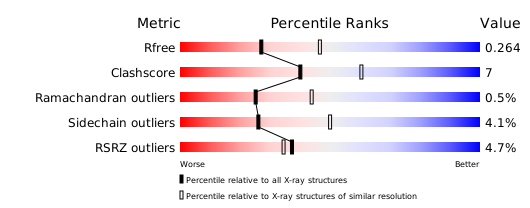
Structure validation
Download full validation report


