






 9K8V
9K8V
Cryo-EM structure of the Type II secretion system protein from Vibrio cholerae
This is a non-PDB format compatible entry.
Summary for 9K8V
| Entry DOI | 10.2210/pdb9k8v/pdb |
| EMDB information | 62181 |
| Descriptor | General secretion pathway protein D (1 entity in total) |
| Functional Keywords | secretion, gspd, nanopore sequencing, protein transport |
| Biological source | Vibrio cholerae |
| Total number of polymer chains | 15 |
| Total formula weight | 683719.64 |
| Authors | Liu, R.H.,Feng, Q.S.,Zhang, K.,Dai, X.,Dai, J.,Guo, X.R.,Lin, W.F.,Wang, Z.F.,Fu, Y.,Li, Y. (deposition date: 2024-10-24, release date: 2025-10-29, Last modification date: 2025-12-24) |
| Primary citation | Liu, R.,Feng, Q.,Zhang, K.,Dai, X.,Dai, J.,Guo, X.,Lin, W.,Wang, Z.,Wu, Q.,Fu, Y.,Li, Y. Tailoring Vibrio-Type Secretin Channel Protein GspD Toward "One-Take" Dual-Constriction Nanopore Sensors. Small, 21:e05878-e05878, 2025 Cited by PubMed Abstract: Dual-constriction nanopores offer a second sensing region that enhances the interactions with analytes at the single-molecule level. However, existing biological nanopore complexes, i.e., CsgG-CsgF, are prone to dissociation upon high voltages, enforcing the development of robust "one-take" platforms. Here, Type II general secretin protein D from Vibrio cholerae (VcGspD) as a promising scaffold with dual-constrictions is proposed and engineered. Biochemical analysis reveals that truncation of the N0-N2 domains yields stable multimerization, with the N3 domain being essential. Cryo-electron microscopy (Cryo-EM) resolves the truncated VcGspD (N0-N2) as a 15-mer architecture, confirming its structural integrity and determining localizations of P471 and F472. By introducing a point mutation at position 346 (S346C) and conjugating cholesterol-maleimide, stable channel insertion in lipid bilayers is achieved. Electrophysiological characterization demonstrates a predominantly low-conductance dual-constriction architecture with constriction diameters of ≈2 nm both at the cap and central constriction sites. The F472A mutation, together with the mutations on both constrictions, gives rise to convergent open-channel current and confers high-voltage stability, thus enabling efficient sensing of both single-stranded DNA and polypeptides. The findings establish VcGspD as a promising platform toward dual-constriction nanopore sensing, paving the way for advancements in the development and engineering of secretin channels. PubMed: 41110147DOI: 10.1002/smll.202505878 PDB entries with the same primary citation |
| Experimental method | ELECTRON MICROSCOPY (2.39 Å) |
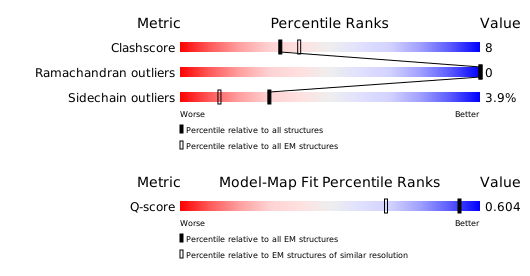
Structure validation
Download full validation report


