






 9K7V
9K7V
Structural insights into photosystem II supercomplex of a a siphonous green algae Bryopsis corticulans from intertidal zone
Summary for 9K7V
| Entry DOI | 10.2210/pdb9k7v/pdb |
| EMDB information | 62153 |
| Descriptor | Photosystem II reaction center protein Z, Lhcb1, Lhcb2, ... (39 entities in total) |
| Functional Keywords | psii-lhcii supercomplex, photosynthesis |
| Biological source | Bryopsis corticulans More |
| Total number of polymer chains | 54 |
| Total formula weight | 1583398.55 |
| Authors | Liu, X.Y.,Wang, W.D. (deposition date: 2024-10-24, release date: 2026-02-25, Last modification date: 2026-09-23) |
| Primary citation | Liu, X.,Li, Z.,Shen, L.,Shen, L.,Wu, B.,Li, X.,Yang, Y.,Gao, S.,Han, G.,Kuang, T.,Liu, C.,Shen, J.R.,Wang, W. Cryo-EM structural analyses of chlorophyll b-enriched PSI-LHC and PSII-LHC supercomplexes of the siphonous green alga Bryopsis corticulans. Plant Commun., 7:101738-101738, 2026 Cited by PubMed Abstract: The light-harvesting complexes of photosystem I (PSI) and PSII (LHCI and LHCII) in Bryopsis corticulans (B. corticulans) are homologous to those in Chlamydomonas reinhardtii and land plants but exhibit a distinct chlorophyll (Chl) and carotenoid composition. Here, we report cryo-electron microscopy structures of the PSI-LHCI-LHCII supercomplex, comprising three LHCII trimers, and the CSMN-type PSII-LHCII supercomplex from B. corticulans. In the PSI supercomplex, ten LHCI subunits assemble into two belts and one heterodimer, coordinating a total of 86 Chl a and 65 Chl b molecules (Chl a/b ratio of 1.3, compared with 3.4 in C. reinhardtii), as well as 18 siphonaxanthin, 2 siphonein, and 13 α-carotene molecules. Of the three LHCII trimers bound to the PSI-LHCI supercomplex, two are anchored to the PSI core primarily via phosphorylated subunits, whereas the third, non-phosphorylated trimer is stabilized through interactions with Lhca-d and the adjacent LHCII trimer. In the CSMN-type PSII-LHCII supercomplex, the N-LHCII is positioned closer to the PSII core than in C. reinhardtii, likely owing to loss of the linker motif in the N-terminal region of B. corticulans CP29. Structure-based energy transfer analysis suggests that this spatial rearrangement enhances the efficiency of excitation energy transfer from N-LHCII to the PSII core. Collectively, these findings reveal structural adaptations that underlie the acclimation strategies of siphonous green algae inhabiting intertidal environments. PubMed: 41578646DOI: 10.1016/j.xplc.2026.101738 PDB entries with the same primary citation |
| Experimental method | ELECTRON MICROSCOPY (3.07 Å) |
Structure validation
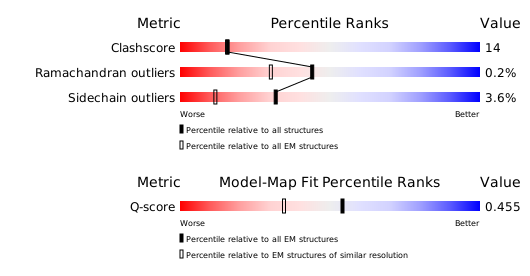
Download full validation report


