






 9K3G
9K3G
Crystal structure of Sortase A from Streptococcus pyogenes in complex with T10
This is a non-PDB format compatible entry.
Summary for 9K3G
| Entry DOI | 10.2210/pdb9k3g/pdb |
| Descriptor | Sortase, [4-[[2,4,6-tris(oxidanylidene)-1,3-diazinan-5-ylidene]methyl]phenyl] (2~{S})-4-methyl-2-(phenylmethoxycarbonylamino)pentanoate, MAGNESIUM ION, ... (4 entities in total) |
| Functional Keywords | inhibitor, cysteine protease, hydrolase |
| Biological source | Streptococcus pyogenes |
| Total number of polymer chains | 2 |
| Total formula weight | 42579.55 |
| Authors | Yang, C.G.,Gan, J. (deposition date: 2024-10-18, release date: 2025-04-02, Last modification date: 2025-06-18) |
| Primary citation | Zhou, H.,Yuan, Z.,Guan, X.N.,Yue, C.,Wu, W.,Lan, L.,Gan, J.,Zhang, T.,Yang, C.G. Structure-Based Development of a Covalent Inhibitor Targeting Streptococcus Pyogenes over Staphylococcus Aureus Sortase A. Chemistry, 31:e202500464-e202500464, 2025 Cited by PubMed Abstract: Sortase A (SrtA), a cysteine transpeptidase critical for surface protein anchoring in Gram-positive pathogens, represents an attractive antivirulence target. While covalent SrtA inhibitors show therapeutic potential, existing compounds lack species selectivity. Through structure-guided design, we developed T10, a covalent inhibitor selectively targeting Streptococcus pyogenes SrtA (SpSrtA) over Staphylococcus aureus SrtA (SaSrtA). Molecular docking revealed that shortening a "C=C" bond in lead compound ML346 eliminated SaSrtA inhibition due to steric hindrance from W194, while maintaining SpSrtA binding. X-ray crystallography confirmed T10's covalent modification of Cys208 in SpSrtA. T10 demonstrated two fold enhanced inhibitory potency and species-specific disruption of M-protein anchoring and biofilm formation in Streptococcus pyogenes, without affecting Staphylococcus aureus viability. In a Galleria mellonella infection model, T10 conferred potent protection against lethal infection. This work demonstrates the development of narrow-spectrum antivirulence agents through a structure-based rational strategy. PubMed: 40072260DOI: 10.1002/chem.202500464 PDB entries with the same primary citation |
| Experimental method | X-RAY DIFFRACTION (1.23 Å) |
Structure validation
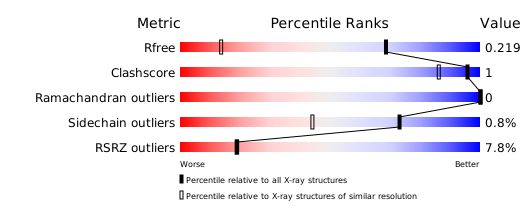
Download full validation report


