






 9JVG
9JVG
Cryo-EM structure of the mmGPR4-Gs complex in pH6.2
Summary for 9JVG
| Entry DOI | 10.2210/pdb9jvg/pdb |
| EMDB information | 61838 |
| Descriptor | Guanine nucleotide-binding protein G(s) subunit alpha isoforms short, G-protein coupled receptor 4, Guanine nucleotide-binding protein G(I)/G(S)/G(T) subunit beta-1, ... (5 entities in total) |
| Functional Keywords | ph6.2, mmgpr4, gs, membrane protein/immune system, membrane protein, membrane protein-immune system complex |
| Biological source | Homo sapiens (human) More |
| Total number of polymer chains | 5 |
| Total formula weight | 160952.61 |
| Authors | Wen, X.,Rong, N.K.,Yang, F.,Sun, J.P. (deposition date: 2024-10-09, release date: 2025-02-26, Last modification date: 2026-03-18) |
| Primary citation | Wen, X.,Shang, P.,Chen, H.,Guo, L.,Rong, N.,Jiang, X.,Li, X.,Liu, J.,Yang, G.,Zhang, J.,Zhu, K.,Meng, Q.,He, X.,Wang, Z.,Liu, Z.,Cheng, H.,Zheng, Y.,Zhang, B.,Pang, J.,Liu, Z.,Xiao, P.,Chen, Y.,Liu, L.,Luo, F.,Yu, X.,Yi, F.,Zhang, P.,Yang, F.,Deng, C.,Sun, J.P. Evolutionary study and structural basis of proton sensing by Mus GPR4 and Xenopus GPR4. Cell, 188:653-670.e24, 2025 Cited by PubMed Abstract: Animals have evolved pH-sensing membrane receptors, such as G-protein-coupled receptor 4 (GPR4), to monitor pH changes related to their physiology and generate adaptive reactions. However, the evolutionary trajectory and structural mechanism of proton sensing by GPR4 remain unresolved. Here, we observed a positive correlation between the optimal pH of GPR4 activity and the blood pH range across different species. By solving 7-cryoelectron microscopy (cryo-EM) structures of Xenopus tropicalis GPR4 (xtGPR4) and Mus musculus GPR4 (mmGPR4) under varying pH conditions, we identified that protonation of H and H enabled polar network establishment and tighter association between the extracellular loop 2 (ECL2) and 7 transmembrane (7TM) domain, as well as a conserved propagating path, which are common mechanisms underlying protonation-induced GPR4 activation across different species. Moreover, protonation of distinct extracellular H contributed to the more acidic optimal pH range of xtGPR4. Overall, our study revealed common and distinct mechanisms of proton sensing by GPR4, from a structural, functional, and evolutionary perspective. PubMed: 39753131DOI: 10.1016/j.cell.2024.12.001 PDB entries with the same primary citation |
| Experimental method | ELECTRON MICROSCOPY (2.76 Å) |
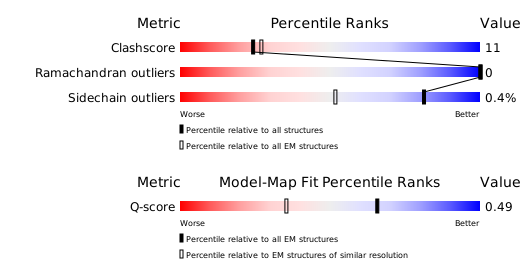
Structure validation
Download full validation report


