






 9JUI
9JUI
Crystal structure of FFAT motif of Nir2 bound to VAPB
Summary for 9JUI
| Entry DOI | 10.2210/pdb9jui/pdb |
| Descriptor | Vesicle-associated membrane protein-associated protein B, Nir2 FFAT motif, ZINC ION, ... (4 entities in total) |
| Functional Keywords | plc signaling, pi cycle, membrane contact site, lipid transfer, lipid binding, lipid binding protein |
| Biological source | Mus musculus (house mouse) More |
| Total number of polymer chains | 2 |
| Total formula weight | 16074.29 |
| Authors | |
| Primary citation | Kim, D.,Lee, S.,Jun, Y.,Lee, C. Nir2 crystal structures reveal a phosphatidic acid-sensing mechanism at ER-PM contact sites. Proc.Natl.Acad.Sci.USA, 122:e2516849122-e2516849122, 2025 Cited by PubMed Abstract: Agonist-induced activation of phosphoinositide-specific phospholipase C (PLC) converts phosphatidylinositol 4,5-bisphosphate [PI(4,5)P] to diacylglycerol (DAG) at the inner leaflet of the plasma membrane (PM). DAG can be enzymatically transformed into phosphatidic acid (PA) and accumulated at the PM. PYK2 N-terminal domain-interacting receptor 2 (Nir2) mediates the formation of ER-PM membrane contact sites (MCSs) by specifically recognizing PA at the PM and directly interacting with ER membrane protein vesicle-associated membrane protein-associated proteins (VAPs). The N-terminal phosphatidylinositol transfer protein domain of Nir2 facilitates PI/PA exchange at ER-PM MCSs to maintain PI and PA levels. Here, we reveal the mechanisms by which Nir2 senses phosphatidic acid (PA) and associates with membranes, based on three crystal structures of its C-terminal Lipin/Ned1/Smp2 (LNS2) domain bound to PA, the diphenylalanine [FF]-containing acidic tract (FFAT) motif complexed with vesicle-associated membrane protein-associated protein B/C (VAPB), and the Asp-Asp-His-Asp (DDHD) domain. The C-terminal LNS2 domain of Nir2 directly interacts with the phosphate in the headgroup of PA via hydrogen bonds involving S1025, T1065, K1103, and K1126. Formation of a salt bridge between E355 in Nir2 and R55 in VAPB is essential for Nir2 FFAT-VAPB interaction. The central DDHD domain of Nir2 forms a twofold symmetric dimer, and this self-association contributes to stable and tight membrane association. These findings reveal how Nir2-mediated ER-PM MCS formation maintains continued PI(4,5)P-dependent PLC signaling. PubMed: 41129229DOI: 10.1073/pnas.2516849122 PDB entries with the same primary citation |
| Experimental method | X-RAY DIFFRACTION (2.05 Å) |
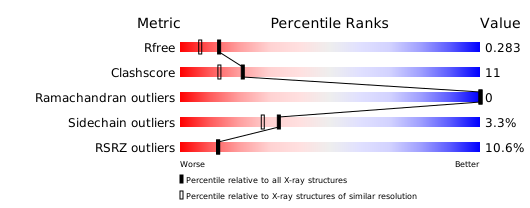
Structure validation
Download full validation report


