






 9JM4
9JM4
Crystal structure of de novo designed light-responsive oligomer C3-7 (LRO-C3-7)
Summary for 9JM4
| Entry DOI | 10.2210/pdb9jm4/pdb |
| Descriptor | LRO-C3-7, SODIUM ION (3 entities in total) |
| Functional Keywords | light-responsive homotrimer, de novo protein |
| Biological source | Escherichia coli |
| Total number of polymer chains | 4 |
| Total formula weight | 31980.27 |
| Authors | |
| Primary citation | Yu, B.,Liu, J.,Cui, Z.,Wang, C.,Chen, P.,Wang, C.,Zhang, Y.,Zhu, X.,Zhang, Z.,Li, S.,Pan, J.,Xie, M.,Shen, H.,Cao, L. De novo design of light-responsive protein-protein interactions enables reversible formation of protein assemblies. Nat.Chem., 17:1910-1919, 2025 Cited by PubMed Abstract: Light-responsive proteins play an essential role in all domains of life by sensing and responding to environmental light signals. However, the de novo design of light-responsive proteins with precisely defined structures and reversible responsive behaviours is an unmet challenge. Here we describe a computational approach to design protein-protein interactions regulated by non-canonical amino acids, focusing on the light-responsive phenylalanine-4'-azobenzene (AzoF). Using this approach, we designed light-responsive cyclic homo-oligomers and heterodimers, which only assemble in AzoF's trans configuration and disassemble when AzoF photoisomerizes to the cis configuration. Biophysical characterization confirms the light-responsive assembly and disassembly of these complexes, and the crystal structures match the design models with atomic accuracy. We demonstrate the applicability of these light-responsive proteins in constructing light-responsive hydrogels and engineering synthetic ligand receptors to optocontrol cell signalling in mammalian cells. Our approach opens avenues for designing environmentally responsive protein structures and broadens the toolkit for optogenetics and optochemistry. PubMed: 40877575DOI: 10.1038/s41557-025-01929-2 PDB entries with the same primary citation |
| Experimental method | X-RAY DIFFRACTION (2.34 Å) |
Structure validation
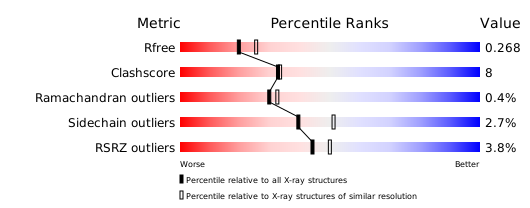
Download full validation report


