






 9JHM
9JHM
Cryo-EM structure of CpAgo_gDNA-tg_bubble_dsDNA monomeric ternary complex
Summary for 9JHM
| Entry DOI | 10.2210/pdb9jhm/pdb |
| EMDB information | 61487 |
| Descriptor | Clostridium perfringen Argonaute, DNA (5'-D(P*TP*GP*AP*GP*GP*TP*AP*GP*TP*AP*GP*GP*TP*TP*GP*TP*AP*TP*AP*GP*T)-3'), DNA (58-MER), ... (4 entities in total) |
| Functional Keywords | pagos, nucleotide-binding pocket, paz, cryo-em, dna binding protein/dna, dna binding protein-dna complex |
| Biological source | Clostridium perfringens More |
| Total number of polymer chains | 3 |
| Total formula weight | 110649.96 |
| Authors | |
| Primary citation | Liu, Y.,Zhang, J.,Liu, J.,Zhang, S.,An, L.,Xie, W.,Zhang, K.,Li, S. The PAZ pocket and dimerization drive CpAgo's guide-independent and DNA-guided dual catalysis. Nat Commun, 16:6599-6599, 2025 Cited by PubMed Abstract: Argonaute proteins (Agos) play essential roles in nucleic acid targeting across life domains. While eukaryotic Agos (eAgos) utilize small-interfering RNAs (siRNAs) or microRNAs (miRNAs) for RNA interference, the mechanisms driving prokaryotic Agos (pAgos) in bacterial defense remain underexplored. Here, we characterize the mesophilic pAgo from Clostridium perfringens (CpAgo), which exhibits robust guide-independent and DNA-guided activity at 37 °C. CpAgo efficiently degrades plasmids and structured RNAs into small fragments, generating DNA fragments that serve as guides for subsequent cleavage. Cryo-electron microscopy reveals a positively-charged PAZ nucleotide-binding pocket, critical for both guide-dependent and guide-independent substrate recognition and cleavage. Structural analysis identifies CpAgo's dimerization as a prerequisite for catalytic activity, supporting both nucleic acid degradation and targeted action. Functional assays in Escherichia coli demonstrate CpAgo's role in bacterial defense by mediating plasmid degradation and DNA-guided cleavage. These findings position CpAgo as a critical component of prokaryotic immunity and a promising tool for biotechnology. PubMed: 40675991DOI: 10.1038/s41467-025-61926-4 PDB entries with the same primary citation |
| Experimental method | ELECTRON MICROSCOPY (3.2 Å) |
Structure validation
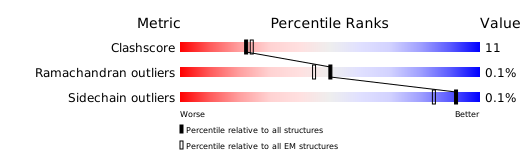
Download full validation report


