






 9J3F
9J3F
The structure of phospholipase TleB
Summary for 9J3F
| Entry DOI | 10.2210/pdb9j3f/pdb |
| Descriptor | Tle1 phospholipase domain-containing protein, GLYCEROL (3 entities in total) |
| Functional Keywords | hydrolyzed phospholipid, toxin |
| Biological source | Xanthomonas oryzae pv. oryzae PXO99A |
| Total number of polymer chains | 1 |
| Total formula weight | 86397.59 |
| Authors | |
| Primary citation | Tan, Z.-.M.,Yang, J.-.T.,Xiao, Q.-.J.,Su, J.-.T.,Wang, Z.-.H.,Jiang, Y.-.T.,Liu, J.-.S.,Pei, T.-.T.,Liang, X.,An, Y.,Xue, H.-.W.,Qin, W.-.M.,Lin, W.-.H.,Dong, T. A phospholipase effector of the type VI secretion system modulates plant reproduction. Mbio, 16:e0154625-e0154625, 2025 Cited by PubMed Abstract: Phytobacteria play diverse roles in plant biology, ranging from promoting health to causing diseases that threaten global food security and the economy. In contrast to the extensive studies of phytopathogens targeting leaves and roots, their impact on plant reproductive processes has been largely overlooked. Here, we demonstrate that a bacterial effector TleB of the type VI secretion system in can modulate seed production of . Using biochemical, structural, and physiological analyses, we determined TleB as a phospholipase that mediates interspecies microbial competition in . Additionally, TleB plays a key role in the infection of inflorescences by , which leads to significantly reduced seed production. Lipidomic and biochemical assays show that TleB binds to a number of anionic phospholipids that are key signaling molecules. A fluorescence reporter for auxin distribution showed TleB-mediated diminished signals . Additionally, transgenic plants expressing TleB exhibited significantly altered seed counts. These findings introduce a novel paradigm in which phytopathogens can affect plant reproduction in a traditionally non-susceptible host, prompting a reevaluation of diverse phytobacteria-host interactions in reproductive processes and offering new insights into plant health and crop protection.IMPORTANCEPhytobacteria are typically identified as pathogens based on visible effects on leaves and roots; those lacking such phenotypes are often considered nonpathogenic. Similarly, plant hosts that show no phenotypic changes are considered nonhosts and, thus, less studied. Our research challenges this classification by highlighting that bacteria-plant interactions on inflorescences, though less apparent and more delayed, can cause profound impacts on seed production. This discovery not only shifts the focus from the more commonly studied vegetative and root infections to the reproductive aspects of plant-pathogen interactions but also necessitates a reevaluation of host-pathogen dynamics with an emphasis on long-term effects such as seed production. PubMed: 40762501DOI: 10.1128/mbio.01546-25 PDB entries with the same primary citation |
| Experimental method | X-RAY DIFFRACTION (1.9 Å) |
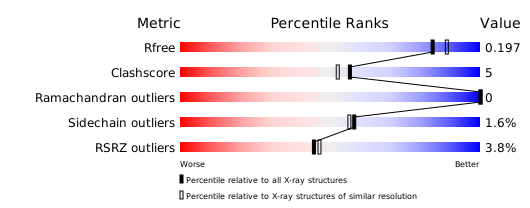
Structure validation
Download full validation report


