






 9J37
9J37
Cryo-EM structure of human Alpha-7 nicotinic acetylcholine receptor
Summary for 9J37
| Entry DOI | 10.2210/pdb9j37/pdb |
| EMDB information | 61108 |
| Descriptor | Neuronal acetylcholine receptor subunit alpha-7, 2-acetamido-2-deoxy-beta-D-glucopyranose-(1-4)-2-acetamido-2-deoxy-beta-D-glucopyranose, 2-acetamido-2-deoxy-beta-D-glucopyranose, ... (4 entities in total) |
| Functional Keywords | receptors, inhibitor, membrane protein |
| Biological source | Homo sapiens (human) |
| Total number of polymer chains | 5 |
| Total formula weight | 276218.54 |
| Authors | |
| Primary citation | Zhang, J.,Yin, Z.,Li, Y.,Ge, C.,Zhang, Z.,Yuan, P.,Jiang, T.,Craik, D.J.,Zhao, Y.,Yu, R. Deep learning-driven discovery and mechanism of action study of a minimalist conopeptide targeting alpha 7 nicotinic acetylcholine receptor. Acta Pharm Sin B, 16:4147-4165, 2026 Cited by PubMed Abstract: Despite extensive structural and functional characterization of the 7 nicotinic acetylcholine receptor, valuable structural insights into its interactions with conopeptides remain limited, thereby hindering the rational development of peptide-based modulators for this clinically important receptor subtype. Here, we present an integrated pipeline combining deep learning, structural biology, computational modeling and electrophysiology to accelerate the discovery and optimization of 7 nAChR-targeting conopeptides. To overcome data scarcity, we developed a deep learning model using the ESM-2 protein language framework, enabling efficient screening of 689 disulfide-poor conopeptides. This approach identified SS1, a novel antagonist of 7 nAChR, which was systematically optimized structure-activity relationship studies to yield [ΔQP,S8R]SS1-a minimalist peptide with nanomolar potency (IC = 49.2 nmol/L), enhanced selectivity, and improved stability. Cryo-EM and computational modeling resolved the 3.3 Å resolution structure of 7 nAChR bound to [S8R]SS1, revealing a unique binding mode stabilized by hydrogen bonds, hydrophobic interactions, and glycan contacts, while hybrid receptor conformations (closed/desensitized) elucidated its inhibitory mechanism. This work establishes a transformative deep learning-to-experiment framework for accelerating the discovery and optimization of nature-inspired peptide therapeutics. PubMed: 42453416DOI: 10.1016/j.apsb.2025.12.035 PDB entries with the same primary citation |
| Experimental method | ELECTRON MICROSCOPY (3.3 Å) |
Structure validation
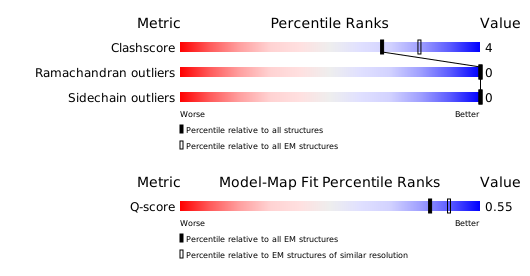
Download full validation report


