






 9IZG
9IZGSummary for 9IZG
| Entry DOI | 10.2210/pdb9izg/pdb |
| EMDB information | 61032 |
| Descriptor | Guanine nucleotide-binding protein G(I)/G(S)/G(T) subunit beta-1, Guanine nucleotide-binding protein G(I)/G(S)/G(O) subunit gamma-2, Soluble cytochrome b562,Lysophosphatidic acid receptor 1,LgBiT tag, ... (7 entities in total) |
| Functional Keywords | gpcr, signaling protein, membrane protein |
| Biological source | Homo sapiens (human) More |
| Total number of polymer chains | 5 |
| Total formula weight | 177678.85 |
| Authors | Suzuki, S.,Nishikawa, K.,Kmegawa, A.,Hiroaki, Y.,Suzuki, H.,Fujiyoshi, Y. (deposition date: 2024-08-01, release date: 2025-01-01, Last modification date: 2025-01-15) |
| Primary citation | Suzuki, S.,Tanaka, K.,Kamegawa, A.,Nishikawa, K.,Suzuki, H.,Oshima, A.,Fujiyoshi, Y. Structural insights into the engagement of lysophosphatidic acid receptor 1 with different G proteins. J.Struct.Biol., 217:108164-108164, 2024 Cited by PubMed Abstract: Lysophosphatidic acid (LPA) and sphingosine-1-phosphate (S1P) are bioactive lysophospholipids derived from cell membranes that activate the endothelial differentiation gene family of G protein-coupled receptors. Activation of these receptors triggers multiple downstream signaling cascades through G proteins such as Gi/o, Gq/11, and G12/13. Therefore, LPA and S1P mediate several physiological processes, including cytoskeletal dynamics, neurite retraction, cell migration, cell proliferation, and intracellular ion fluxes. The basis for the G-protein coupling selectivity of EDG receptors, however, remains unknown. Here, we present cryo-electron microscopy structures of LPA-activated LPA1 in complexes with G, G, and G heterotrimers Comparison of the three LPA1-G protein structures shows clearly different conformations of intracellular loop 2 (ICL2) and ICL3 that are likely induced by the different Gα protein interfaces. Interestingly, this G-protein interface interaction is a common feature of LPA and S1P receptors. Our findings provide clues to understanding the promiscuity of G-protein coupling in the endothelial differentiation gene family. PubMed: 39725093DOI: 10.1016/j.jsb.2024.108164 PDB entries with the same primary citation |
| Experimental method | ELECTRON MICROSCOPY (3.04 Å) |
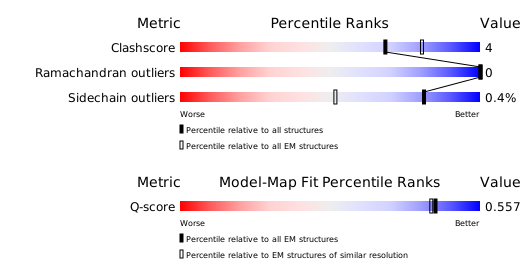
Structure validation
Download full validation report


