






 9IRM
9IRM
Structure of ClpP from Staphylococcus aureus in complex with ZG283
Summary for 9IRM
| Entry DOI | 10.2210/pdb9irm/pdb |
| Descriptor | ATP-dependent Clp protease proteolytic subunit, (6S,9aS)-8-(anthracen-9-ylmethyl)-6-[(2S)-butan-2-yl]-4,7-bis(oxidanylidene)-N-[4,4,4-tris(fluoranyl)butyl]-3,6,9,9a-tetrahydro-2H-pyrazino[1,2-a]pyrimidine-1-carboxamide, (4S)-2-METHYL-2,4-PENTANEDIOL, ... (4 entities in total) |
| Functional Keywords | clpp, staphylococcus aureus, activator, protease, hydrolase |
| Biological source | Staphylococcus aureus |
| Total number of polymer chains | 14 |
| Total formula weight | 311363.04 |
| Authors | Wei, B.Y.,Wang, P.Y.,Zhang, T.,Yang, C.-G. (deposition date: 2024-07-16, release date: 2024-10-23, Last modification date: 2025-02-19) |
| Primary citation | Zhang, T.,Wang, P.,Zhou, H.,Wei, B.,Zhao, Y.,Li, J.,Zhang, M.,Wu, W.,Lan, L.,Gan, J.,Yang, C.G. Structure-guided development of selective caseinolytic protease P agonists as antistaphylococcal agents. Cell Rep Med, 5:101837-101837, 2024 Cited by PubMed Abstract: Methicillin-resistant Staphylococcus aureus is a ubiquitous pathogen, posing a serious threat to human health worldwide. Thus, there is a high demand for antibiotics with distinct targets. Caseinolytic protease P (ClpP) is a promising target for combating staphylococcal infections; however, selectively activating S. aureus ClpP (SaClpP) rather than Homo sapiens ClpP (HsClpP) remains challenging. Herein, we rationally design and identify ZG297 by structure-based strategy. It binds and activates SaClpP instead of HsClpP. This is due to differentiated ligand binding attributed to crossed "tyrosine/histidine" amino acid pairs. ZG297 substantially inhibits the growth of a broad panel of S. aureus strains in vitro, outperforming the selective (R)-ZG197 agonist. ZG297 also functions as a potent antibiotic against multidrug-resistant S. aureus infections in Galleria mellonella larvae, zebrafish, murine skin, and thigh infection models. Collectively, we demonstrate that ZG297 is a safer and more potent antistaphylococcal agent than acyldepsipeptide 4 and (R)-ZG197. PubMed: 39615486DOI: 10.1016/j.xcrm.2024.101837 PDB entries with the same primary citation |
| Experimental method | X-RAY DIFFRACTION (1.81 Å) |
Structure validation
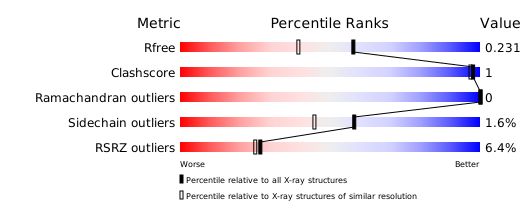
Download full validation report


