






 9IGQ
9IGQ
Crystal structure of PPK2 class III from Erysipelotrichaceae bacterium in complex with AppCH2p and polyphosphate
This is a non-PDB format compatible entry.
Summary for 9IGQ
| Entry DOI | 10.2210/pdb9igq/pdb |
| Related | 9IGR |
| Descriptor | Polyphosphate--nucleotide phosphotransferase, PHOSPHOMETHYLPHOSPHONIC ACID ADENYLATE ESTER, bis[oxidanyl-[oxidanyl-[oxidanyl-[oxidanyl(phosphonooxy)phosphoryl]oxy-phosphoryl]oxy-phosphoryl]oxy-phosphoryl] hydrogen phosphate, ... (9 entities in total) |
| Functional Keywords | polyphosphate kinase, ppk2-iii, ntp, ebppk, transferase |
| Biological source | Erysipelotrichaceae bacterium |
| Total number of polymer chains | 4 |
| Total formula weight | 152407.06 |
| Authors | Rasche, R.,Lawrence-Doerner, A.-M.,Cornelissen, N.V.,Kuemmel, D. (deposition date: 2025-02-20, release date: 2025-07-23, Last modification date: 2025-08-13) |
| Primary citation | Mitton-Fry, R.M.,Rasche, R.,Lawrence-Dorner, A.M.,Eschenbach, J.,Tekath, A.,Rentmeister, A.,Kummel, D.,Cornelissen, N.V. Structure-guided engineering of a polyphosphate kinase 2 class III from an Erysipelotrichaceae bacterium to produce base-modified purine nucleotides. Rsc Chem Biol, 6:1328-1335, 2025 Cited by PubMed Abstract: Nucleobase-modified nucleoside-5'-triphosphates (NTPs) are important building blocks for the enzymatic synthesis of non-coding RNAs and mRNAs with improved properties. Chemical phosphorylation of base-modified nucleotides to NTPs remains challenging. Here, we report the enzymatic phosphorylation of purine-modified nucleoside-5'-monophosphates (NMPs) to the corresponding NTPs by the polyphosphate kinase 2 class III from an bacterium (EbPPK2). The enzyme is highly promiscuous, accepting a range of NMPs with purine modifications. EbPPK2 efficiently catalyses the formation of the corresponding di-, tri- and tetraphosphates, typically with >70% conversion to the NTP. Slower conversion was observed for analogues with oxo- or thio-substitutions at the C6-position. To better understand nucleotide binding and catalysis, we determined the crystal structure of EbPPK2 at 1.7 Å resolution bound to a non-hydrolysable ATP analogue and polyphosphate. This enabled structure-guided design of EbPPK2 variants that efficiently convert GMP analogues, while retaining activity for AMP. Apart from being the preferred industrial-scale ATP recycling catalyst, EbPPK2 and variants bear potential to become the favoured enzyme family for purine-modified NTP production. PubMed: 40667417DOI: 10.1039/d5cb00108k PDB entries with the same primary citation |
| Experimental method | X-RAY DIFFRACTION (1.7 Å) |
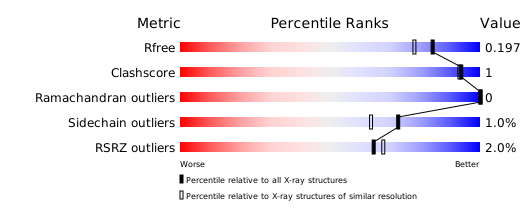
Structure validation
Download full validation report


