






 9IE1
9IE1
Human Deoxyhypusine Synthase Fragment Screening Campaign - ligand VT00223
This is a non-PDB format compatible entry.
Summary for 9IE1
| Entry DOI | 10.2210/pdb9ie1/pdb |
| Descriptor | Deoxyhypusine synthase, NICOTINAMIDE-ADENINE-DINUCLEOTIDE, 2-fluoranyl-~{N},~{N}-dimethyl-benzenesulfonamide, ... (5 entities in total) |
| Functional Keywords | fragment screening, polyamines, high-throughput, posttranslational modifications, transferase |
| Biological source | Homo sapiens (human) |
| Total number of polymer chains | 2 |
| Total formula weight | 83940.49 |
| Authors | Wilk, P.,Wator-Wilk, E.,Krojer, T.,Grudnik, P. (deposition date: 2025-02-15, release date: 2026-01-21, Last modification date: 2026-02-18) |
| Primary citation | Wilk, P.,Wator-Wilk, E.,Muszak, D.,Kochanowski, P.,Krojer, T.,Grudnik, P. Crystallographic fragment screening supports tool compound discovery and reveals conformational flexibility in human deoxyhypusine synthase. Commun Chem, 9:66-66, 2026 Cited by PubMed Abstract: Deoxyhypusine synthase (DHS) catalyzes the rate-limiting step of hypusination, a unique post-translational modification of eukaryotic translation factor 5 A (eIF5A). While DHS activity plays a critical role in both normal cellular processes and disease development, the lack of specific molecular tools has hindered detailed studies of this enzyme and the hypusination pathway in general. Existing inhibitors, such as polyamine analogs, suffer from limited specificity and versatility. In this study, we utilized crystallographic fragment screening (CFS) to identify potential DHS inhibitors and explore novel applications of this approach. With an unprecedented hit rate of 39%, we identified fragment clusters binding at key sites, including the active site entrance, the tetramer interface, the regulatory ball-and-chain motif, and potentially allosteric regions on the enzyme's surface. Notably, we discovered a covalent modifier that targets the catalytic lysine residue in an oxidoreductase reaction-specific manner, as well as fragments that induce significant structural rearrangements of crucial regulatory elements. Our findings establish a framework for extending CFS beyond traditional inhibitor discovery, demonstrating its utility in probing protein dynamics, identifying novel binding pockets, and investigating regulatory mechanisms. These results offer new insights into DHS function, hypusination dynamics, and the broader methodological advancements that CFS contributes to structural biology and protein regulation research. PubMed: 41548022DOI: 10.1038/s42004-026-01897-9 PDB entries with the same primary citation |
| Experimental method | X-RAY DIFFRACTION (1.35 Å) |
Structure validation
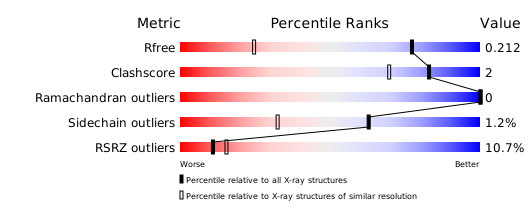
Download full validation report


