






 9I5R
9I5R
Interactions between Pex3 and Pex19 peptide in yeast
Summary for 9I5R
| Entry DOI | 10.2210/pdb9i5r/pdb |
| Descriptor | Peroxisomal biogenesis factor 3, Peroxin19 Pex19p (2 entities in total) |
| Functional Keywords | peroxisome, protein transport |
| Biological source | Ogataea angusta More |
| Total number of polymer chains | 2 |
| Total formula weight | 50756.68 |
| Authors | de Lange, E.,Chojnowski, G.,Burgi, J.,Vlijm, R.,Wilmanns, M.,van der Klei, I. (deposition date: 2025-01-28, release date: 2025-02-19, Last modification date: 2026-01-21) |
| Primary citation | de Lange, E.M.F.,Chojnowski, G.,Burgi, J.,Vlijm, R.,Wilmanns, M.,van der Klei, I.J. Competition between binding partners of yeast Pex3 affects peroxisome biology. Febs J., 293:175-195, 2026 Cited by PubMed Abstract: Peroxisomes are important membrane-bound organelles that are involved in a multitude of metabolic processes. Peroxisomal biogenesis factor 3 (Pex3) is a crucial peroxisomal membrane protein (PMP) that plays a vital role in many of these processes through the specific recruitment of several binding partners. In the yeast Hansenula polymorpha, Pex3 recruits PMP import receptor Pex19, the receptor for newly synthesized PMPs; autophagy-related protein 30 (Atg30), a protein involved in the selective breakdown of peroxisomes (pexophagy); and inheritance of peroxisomes protein 1 (Inp1), a protein important for peroxisome retention in mother cells. Here, we show that the overexpression of any of these proteins affects peroxisomal processes, with the level of overexpression being the primary determinant of competition. This finding is confirmed by our analysis based on the crystal structure model of the H. polymorpha Pex3-Pex19 complex and AlphaFold2 predictions. It shows that the interaction regions of Pex3 with these proteins overlap. These results provide a crucial insight into the complex role of Pex3 in regulating different processes in peroxisome biology. PubMed: 40847603DOI: 10.1111/febs.70229 PDB entries with the same primary citation |
| Experimental method | X-RAY DIFFRACTION (2.62 Å) |
Structure validation
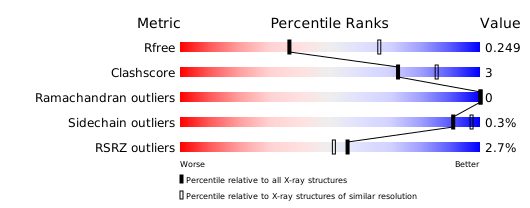
Download full validation report


