






 9I5N
9I5N
Single particle cryo electron microscopy of a Fab fragment bound to recombinant human CD40 ligand
Summary for 9I5N
| Entry DOI | 10.2210/pdb9i5n/pdb |
| EMDB information | 52634 |
| Descriptor | Fab20 heavy chain, Fab20 light chain, CD40 ligand, soluble form, ... (5 entities in total) |
| Functional Keywords | cd40 ligand inhibitor, cd154 inhibitor, autoimmunity, fab fragment, immune system |
| Biological source | Mus musculus More |
| Total number of polymer chains | 3 |
| Total formula weight | 40134.12 |
| Authors | Kristoffersen, E.L.,Schinkel, T.,Andersen, E.S. (deposition date: 2025-01-28, release date: 2026-02-25, Last modification date: 2026-03-11) |
| Primary citation | Pedersen, K.,Green, K.,Kristoffersen, E.L.,Schinkel, T.,Hansen, A.G.,Palarasah, Y.,Rovsing, A.B.,Andersen, E.S.,Valero, J.,Civit, L.,Laursen, N.S.,Troldborg, A.,Degn, S.E.,Thiel, S. Curbing Autoimmunity: A New Fab Fragment Targeting CD40-CD40L Halts B-Cell Activation and Differentiation. Eur.J.Immunol., 56:e70158-e70158, 2026 Cited by PubMed Abstract: Dysregulation of the CD40-CD40L axis is implicated in autoimmune diseases. Early clinical trials targeting CD40L with antibodies failed due to Fc-mediated side effects. To address this, we developed an anti-CD40L Fab fragment, Fab20, designed to block B-cell activation. Fab20 was evaluated for its binding properties, CD40-CD40L inhibition, and effects on human B-cell activation and differentiation using immunoassays, cryo-electron microscopy, flow cytometry, and cell cultures. Fab20 binds CD40L with a dissociation constant of 70 nM. Structural analysis revealed a "propeller-like" structure consisting of three Fabs binding to the CD40L trimer, sterically blocking parts of the CD40 binding site. Fab20 effectively inhibited B-cell activation, maintaining naïve B cells in their inactive state, and suppressed antibody (IgG) production over 14 days. Fab20 represents a promising novel therapeutic approach for treating autoimmune diseases driven by CD40-CD40L dysregulation. Its mechanism of action, coupled with the absence of Fc-mediated effects, suggests a favorable safety profile. PubMed: 41742604DOI: 10.1002/eji.70158 PDB entries with the same primary citation |
| Experimental method | ELECTRON MICROSCOPY (3.4 Å) |
Structure validation
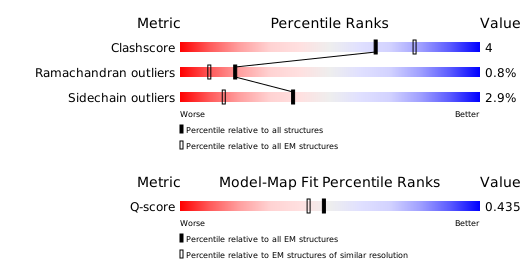
Download full validation report


