






 9I5K
9I5K
Structure of the Chaetomium thermophilum Pmt4 homodimer (C2 symmetry)
This is a non-PDB format compatible entry.
Summary for 9I5K
| Entry DOI | 10.2210/pdb9i5k/pdb |
| Related | 9FD0 9FD1 |
| EMDB information | 52631 |
| Descriptor | Dolichyl-phosphate-mannose--protein mannosyltransferase, dolichol-phosphate-mannose (n=2), dolichol-phosphate (n=4) (3 entities in total) |
| Functional Keywords | homodimer, glycosylation, er, biogenesis, membrane protein |
| Biological source | Thermochaetoides thermophila |
| Total number of polymer chains | 2 |
| Total formula weight | 186780.68 |
| Authors | |
| Primary citation | McDowell, M.A.,Wild, K.,Fiorentino, F.,Bausewein, D.,Metschies, A.,Chiapparino, A.,Hackmann, Y.,Bilsing, F.L.,Brenske, D.,Mortensen, S.,Wu, D.,Robinson, C.V.,Strahl, S.,Sinning, I. Structural characterisation of the fungal Pmt4 homodimer. Nat Commun, 16:11134-11134, 2025 Cited by PubMed Abstract: Protein O-mannosyltransferases (PMTs) are conserved endoplasmic reticulum membrane-embedded enzymes responsible for the transfer of mannose from dolichol phosphate-mannose (Dol-P-Man) to serine/threonine-rich protein substrates or unfolded proteins. PMTs from three subfamilies form obligate dimers with different substrate specificities and require the concerted action of their transmembrane domains (TMDs) and a luminal MIR domain for catalysis. Here, we present structures, native mass spectrometry, and structure-based mutagenesis of the fungal Pmt4 homodimer. The core fold of the TMDs and MIR domain is conserved with the Pmt1-Pmt2 heterodimer, indicating a shared catalytic mechanism. Distinct from Pmt4, the MIR domain interacts in cis with the TMDs of the same subunit and has a β-hairpin insertion required for O-mannosylation of substrates. We further identify a cytosolic binding site for substrate Dol-P-Man within the Pmt4 TMDs, which is conserved amongst PMTs and important for in vivo activity. Thus, we provide a framework to understand the substrate specificity and regulation of the Pmt4 homodimer. PubMed: 41392315DOI: 10.1038/s41467-025-67412-1 PDB entries with the same primary citation |
| Experimental method | ELECTRON MICROSCOPY (3.2 Å) |
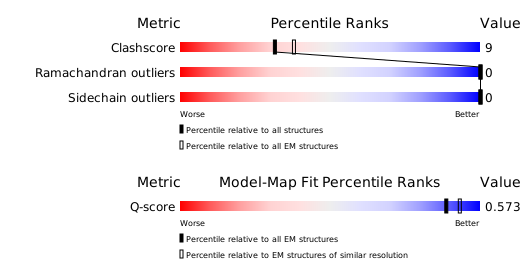
Structure validation
Download full validation report


