






 9I37
9I37
Csu pilus rod purified from Acinetobacter baumannii
Summary for 9I37
| Entry DOI | 10.2210/pdb9i37/pdb |
| Related | 7ZL4 |
| EMDB information | 52587 |
| Descriptor | CsuA/B (1 entity in total) |
| Functional Keywords | pili, fimbriae, acinetobacter baumannii pili, chaperone-usher pathway, archaic chaperone-usher pili, biofilm, 3d biofilm, adhesion, pathogenesis, cell adhesion |
| Biological source | Acinetobacter baumannii |
| Total number of polymer chains | 9 |
| Total formula weight | 144626.78 |
| Authors | Malmi, H.,Zavialov, A.V.,Pakharukova, N. (deposition date: 2025-01-22, release date: 2025-12-17, Last modification date: 2026-04-01) |
| Primary citation | Malmi, H.,Pakharukova, N.,Paul, B.,Tuittila, M.,Ahmad, I.,Knight, S.D.,Uhlin, B.E.,Ghosal, D.,Zavialov, A.V. Antiparallel stacking of Csu pili drives Acinetobacter baumannii 3D biofilm assembly. Nat Commun, 17:-, 2026 Cited by PubMed Abstract: Many Gram-negative nosocomial pathogens rely on adhesive filaments, known as archaic chaperone-usher pili, to establish stress- and drug-resistant, multi-layered biofilms. Here, we uncover the mechanism by which these pili build three-dimensional (3D) biofilm architectures. In situ analyses of Acinetobacter baumannii biofilms using electron microscopy (EM) reveal an extensive network of ultrathin, flat stacks of archaic Csu pili interconnecting bacterial cells in 3D space. Cryo-EM structures of a single native pilus, pilus pairs, and two types of multi-pilus stacks show that the pili pack into antiparallel sheets, with their rods connected laterally by junctions at their zigzag corners. This antiparallel arrangement ensures that contacts form primarily between pili from interacting cells rather than pili from the same cell. With a remarkably short helical repeat, archaic chaperone-usher pili spontaneously establish a high density of junctions that determines the biofilm's 3D architecture. Our findings may help develop new therapies against multidrug-resistant bacterial infections by targeting pilus-pilus interactions. PubMed: 41654547DOI: 10.1038/s41467-026-68860-z PDB entries with the same primary citation |
| Experimental method | ELECTRON MICROSCOPY (3.28 Å) |
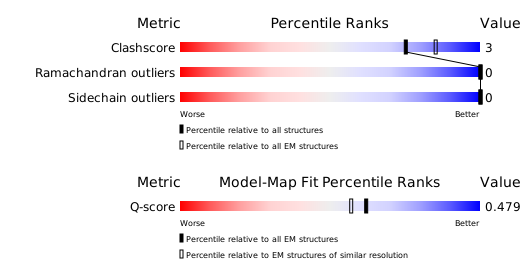
Structure validation
Download full validation report


