






 9I0U
9I0U
Structure of human PD-L1 in complex with clinically evaluated inhibitor
This is a non-PDB format compatible entry.
Summary for 9I0U
| Entry DOI | 10.2210/pdb9i0u/pdb |
| Related | 9HRT |
| Descriptor | Programmed cell death 1 ligand 1, GLYCEROL, (5~{S})-5-[[[5-[2-chloranyl-3-[2-chloranyl-3-[6-methoxy-5-[[[(2~{S})-5-oxidanylidenepyrrolidin-2-yl]methylamino]methyl]pyrazin-2-yl]phenyl]phenyl]-3-methoxy-pyrazin-2-yl]methylamino]methyl]pyrrolidin-2-one, ... (4 entities in total) |
| Functional Keywords | small-molecule inhibitor, pd-1 pathway, programmed death-ligand 1, immune system |
| Biological source | Homo sapiens (human) |
| Total number of polymer chains | 2 |
| Total formula weight | 30783.96 |
| Authors | Golebiowska-Mendroch, K.,Slota, A.,Plewka, J.,Magiera-Mularz, K. (deposition date: 2025-01-15, release date: 2025-06-18, Last modification date: 2025-07-30) |
| Primary citation | Slota, A.,Golebiowska-Mendroch, K.,Kocik-Krol, J.,Musielak, B.,Stec, M.,Weglarczyk, K.,Siedlar, M.,Skalniak, L.,Plewka, J.,Magiera-Mularz, K. Characterization of Clinically Evaluated Small-Molecule Inhibitors of PD-L1 for Immunotherapy. Acs Med.Chem.Lett., 16:1359-1364, 2025 Cited by PubMed Abstract: Cancer immunotherapy aims to employ the immune system to target cancer cells. The PD-1/PD-L1 axis is a critical immune checkpoint that tumors exploit to evade immune surveillance. In this study, we characterized three small-molecule PD-L1 inhibitors, Evixapodlin, MAX-10181, and INCB086550, currently undergoing clinical trials for cancers such as non-small cell lung cancer, renal cell carcinoma, urothelial carcinoma, hepatocellular carcinoma, and melanoma. Using the homogeneous time resolved fluorescence assay, we confirmed that each compound potently disrupts human PD-1/PD-L1 binding with IC values in the nanomolar range. PD-L1 oligomerization upon inhibitor binding was demonstrated through NMR analysis and confirmed by X-ray crystallography, which finally elucidated the binding interactions that stabilize these inhibitors at the PD-L1 interface. Cellular assays revealed dose-dependent T-cell activation, demonstrating the immunomodulatory potential of each compound and its cytotoxicity profiles. These findings underscore the promise of small-molecule PD-L1 inhibitors as viable alternatives to antibody-based therapies in cancer immunotherapy. PubMed: 40666457DOI: 10.1021/acsmedchemlett.5c00245 PDB entries with the same primary citation |
| Experimental method | X-RAY DIFFRACTION (1.46 Å) |
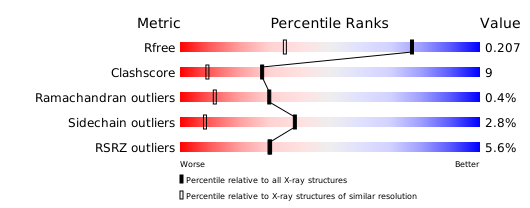
Structure validation
Download full validation report


