






 9HTZ
9HTZ
M2-32, a new class A acid phosphatase
Summary for 9HTZ
| Entry DOI | 10.2210/pdb9htz/pdb |
| Descriptor | Phosphatase PAP2 family protein, ACETATE ION, 1,2-ETHANEDIOL, ... (7 entities in total) |
| Functional Keywords | class-a bacterial, thermotolerant acid phosphatase, hydrolase |
| Biological source | metagenome |
| Total number of polymer chains | 4 |
| Total formula weight | 117617.99 |
| Authors | Gavira, J.A.,Ramos, J.L.,Martinez-Rodriguez, S.,Recio, M.I.,de la Torre, J. (deposition date: 2024-12-20, release date: 2025-09-17) |
| Primary citation | Recio, M.I.,Gavira, J.A.,de La Torre, J.,Cano-Munoz, M.,Martinez-Rodriguez, S.,Daddaoua, A.,Duque, E.,Ramos, J.L. Thermotolerant class A acid phosphatase active across broad pH range and diverse substrates. Protein Sci., 34:e70244-e70244, 2025 Cited by PubMed Abstract: M2-32 is a non-specific acid phosphatase with a rare ability to function across a broad pH range (3.5-8.5). Analysis using SWISS-PROT Prf Profiles classifies it as a class A acid phosphatase (Z-score: 78.97), sharing 50%-60% sequence similarity with enzymes such as PhoC and PhoN. For detailed characterization, the gene encoding M2-32 was cloned into the pET28(b) vector, overexpressed in Escherichia coli BL21 (DE3), and subsequently purified. Although the monomeric form of M2-32 has a molecular weight of ~28 kDa, size exclusion chromatography, dynamic light scattering, and sedimentation studies revealed a dimeric form in solution. Enzymatic assays using p-nitrophenyl phosphate, 4-methylumbelliferyl phosphate, 3'-and 5'-adenosine monophosphate demonstrated robust activity over a pH range of 4.0-8.0 at both 30 and 50°C. Differential scanning fluorimetry indicated an unfolding temperature close to 47°C; however, the enzyme refolded after heat denaturation at 80°C. We have determined the x-ray crystal structure of M2-32 by molecular replacement using an AlphaFold2-guided truncated model, achieving a resolution of 2.2 Å. The protein crystallized as a dimer-of-dimers. Each monomer (residues 38-274) adopts an all-alpha-helical fold composed of 14 helices and two disulfide bonds. Docking studies with adenosine monophosphates, combined with site-directed mutagenesis, identified His174, Arg207, His213, Asp217 as critical catalytic residues, and Tyr136 and Ser172 probably involved in substrate recognition. Mutations at these positions resulted in over 90% loss of enzymatic activity, highlighting their functional significance. PubMed: 40815342DOI: 10.1002/pro.70244 PDB entries with the same primary citation |
| Experimental method | X-RAY DIFFRACTION (2.2 Å) |
Structure validation
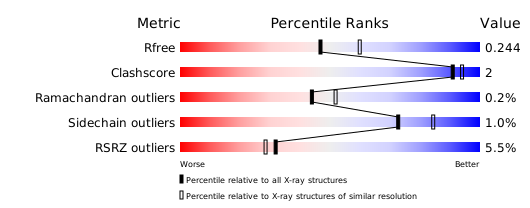
Download full validation report


