






 9HS1
9HS1
Crystal structure of the Escherichia coli nucleosidase PpnN (partial alarmone form)
Summary for 9HS1
| Entry DOI | 10.2210/pdb9hs1/pdb |
| Descriptor | Pyrimidine/purine nucleotide 5'-monophosphate nucleosidase, guanosine 5'-(tetrahydrogen triphosphate) 3'-(trihydrogen diphosphate), GUANINE, ... (5 entities in total) |
| Functional Keywords | nucleosidase, pppgpp, gmp, hydrolase |
| Biological source | Escherichia coli K-12 |
| Total number of polymer chains | 4 |
| Total formula weight | 208898.41 |
| Authors | Baerentsen, R.L.,Brodersen, D.E. (deposition date: 2024-12-18, release date: 2025-11-12, Last modification date: 2026-01-21) |
| Primary citation | Baerentsen, R.L.,Kronborg, K.,Brodersen, D.E.,Zhang, Y.E. Catalytic mechanism and differential alarmone regulation of a conserved stringent nucleosidase. Structure, 34:198-209.e4, 2026 Cited by PubMed Abstract: Insights into bacterial metabolic adaptation during stress is crucial for understanding early mechanisms of antibiotic resistance. In the Gram-negative bacterium Escherichia coli, the universal stringent response produces the alarmones (p)ppGpp that target many cellular proteins. The cellular nucleosidase PpnN is regulated by (p)ppGpp and was shown to balance bacterial fitness and persistence during fluoroquinolone exposure. pppGpp and ppGpp both activate PpnN, but differentially regulate its cooperativity via an unknown mechanism; furthermore, the catalytic mechanism of PpnN has remained unclear. Here, we provide mechanistic insights into the interaction of PpnN with a substrate analogue, reaction products, and alarmone molecules, which allows us to understand the catalytic mechanism of this family of nucleosidases and the differential modes of regulation by ppGpp and pppGpp, respectively. Comparison to the homologous plant cytokinin-producing LOG proteins reveals that PpnN utilizes an evolutionarily conserved purine hydrolysis mechanism, which in bacteria is regulated by alarmones during stress. PubMed: 41197623DOI: 10.1016/j.str.2025.10.012 PDB entries with the same primary citation |
| Experimental method | X-RAY DIFFRACTION (2.36 Å) |
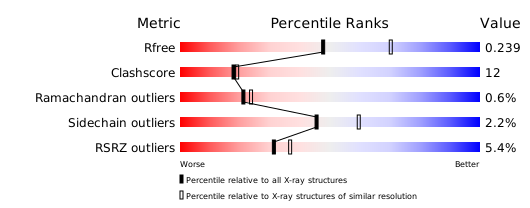
Structure validation
Download full validation report


