






 9HRF
9HRF
Crystal structure of the Class V (UU) GTP aptamer variant in complex with GTP
Summary for 9HRF
| Entry DOI | 10.2210/pdb9hrf/pdb |
| Descriptor | Class V (UU) GTP aptamer, GUANOSINE-5'-TRIPHOSPHATE, POTASSIUM ION, ... (6 entities in total) |
| Functional Keywords | rna-aptamer gtp g-quadruplex potassium ion, rna |
| Biological source | synthetic construct |
| Total number of polymer chains | 1 |
| Total formula weight | 23362.61 |
| Authors | |
| Primary citation | Stafflinger, H.,Neissner, K.,Bartsch, S.,Pichler, A.K.,Bartosik, K.,Dhamotharan, K.,Abele, R.,Duchardt-Ferner, E.,Micura, R.,Schindelin, H.,Wohnert, J. Crystal structure of the class V GTP-binding RNA aptamer bound to its ligand: GTP recognition by a topologically complex intermolecular G-quadruplex. Nucleic Acids Res., 53:-, 2025 Cited by PubMed Abstract: RNA aptamers obtained from in vitro selection experiments provide unique insights into the structural properties and ligand recognition capabilities of RNA in general. In order to investigate the relationships between RNA sequence information content and structural complexity with ligand affinity and specificity, the Szostak group previously identified eleven different families of GTP-binding aptamers varying widely in their sequence conservation patterns as well as in their secondary structure complexity and topology. The class V GTP aptamer has a particularly high affinity for GTP. Here, we report the high-resolution X-ray crystal structure of this aptamer-GTP complex. Remarkably, GTP is found to be integrated into one layer of a two-layered G-quadruplex, thereby rationalizing the high ligand affinity and the observed specificity. The G-quadruplex is extended on one side by a noncanonical tetrad layer containing three non-G nucleotides and on the other side by a Watson-Crick base pair stacking on top of an unpaired adenine. Interestingly, the G-nucleotides forming the G-quadruplex originate from two asymmetric bulges separated by an 8 base pair A-form helix, resulting in a complex and previously unobserved G-quadruplex topology. PubMed: 41422825DOI: 10.1093/nar/gkaf1315 PDB entries with the same primary citation |
| Experimental method | X-RAY DIFFRACTION (1.6 Å) |
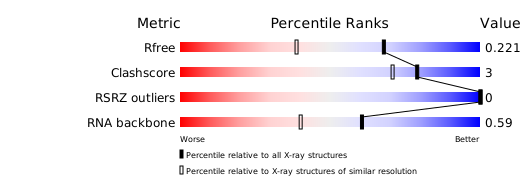
Structure validation
Download full validation report


