






 9HO1
9HO1
Room temperature structure of Aspartyl/Asparaginyl beta-hydroxylase (AspH) in complex with Fe, 2-oxoglutarate, and hydroxylated Factor X derived peptide fragment, 1.5 s O2 exposure
Summary for 9HO1
| Entry DOI | 10.2210/pdb9ho1/pdb |
| Related | 6Q9F |
| Descriptor | Aspartyl/asparaginyl beta-hydroxylase, Factor X light chain, 2-OXOGLUTARIC ACID, ... (6 entities in total) |
| Functional Keywords | asph, aspartyl/asparaginyl beta-hydroxylase, o2 exposure, product complex, oxidoreductase |
| Biological source | Homo sapiens (human) More |
| Total number of polymer chains | 2 |
| Total formula weight | 53931.75 |
| Authors | de Munnik, M.,Rabe, P.,Brewitz, L.,Brasnett, A.,Zhou, T.,Schofield, C.J.,Kern, J.F. (deposition date: 2024-12-11, release date: 2025-12-24, Last modification date: 2026-05-27) |
| Primary citation | de Munnik, M.,Brasnett, A.,Zhou, T.,Myers, W.,Wang, Y.,Chatterjee, K.,Tumber, A.,Marshall, S.A.,Simon, P.S.,Aller, P.,Shilova, A.,Axford, D.,Makita, H.,Paley, D.W.,Tiwari, V.,Stead, A.T.,Dehe, S.,Sanchez, H.,Rosenberg, D.J.,Alonso-Mori, R.,Bhowmick, A.,Yano, J.,Yachandra, V.K.,Park, J.,Park, S.,Orville, A.M.,Brewitz, L.,Kern, J.F.,Schofield, C.J.,Rabe, P. Structural basis of the promiscuity of the unusual Fe(II) and 2-oxoglutarate dependent human aspartate/asparagine-beta-hydroxylase. Nat Commun, 17:-, 2026 Cited by PubMed Abstract: Protein-hydroxylation catalysed by Fe(II) and 2-oxoglutarate (2OG) dependent oxygenases is an important regulatory mechanism in human biology. Such oxygenases typically coordinate their Fe(II) cofactor via a conserved triad of an aspartate- or glutamate- and two histidine-residues. By contrast, aspartate/asparagine β-hydroxylase (AspH), which catalyses asparagine/aspartate-residue oxidation in epidermal growth factor-like domains (EGFDs), has only two histidine-residues (H679, H725), with a water occupying the site normally occupied by an aspartate- or glutamate-residue. We describe mechanistic studies with catalytically active AspH crystals. Turnover studies with single crystals under cryogenic conditions give (3 R)-hydroxylated EGFDs with the product alcohol coordinating Fe(II) trans to H725. Time-resolved serial crystallography of microcrystals using an acoustic droplet ejection system, coupled to X-ray emission analyses, demonstrate turnover within 1.5 s, giving a product complex in which Fe(II) is regenerated. Solution and crystallographic studies with the O surrogate nitric oxide imply O binds to Fe(II) trans to H725. The additional Fe-chelating water is maintained throughout AspH catalysis and is not directly involved in substrate hydroxylation, because O is the sole oxygen source in alcohol products, as shown by O labelling studies. The results reveal how AspH accommodates both aspartate- and asparagine-substrates and will assist in efforts targeting AspH for cancer treatment. PubMed: 41741441DOI: 10.1038/s41467-026-69425-w PDB entries with the same primary citation |
| Experimental method | X-RAY DIFFRACTION (1.85 Å) |
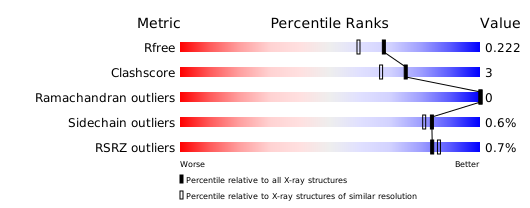
Structure validation
Download full validation report


