






 9HGG
9HGG
SETD2 peptide bound to SPOP MATH domain
Summary for 9HGG
| Entry DOI | 10.2210/pdb9hgg/pdb |
| Descriptor | Speckle-type POZ protein, Histone-lysine N-methyltransferase SETD2, MAGNESIUM ION, ... (4 entities in total) |
| Functional Keywords | ubiquitination, ligase, complex, degradation |
| Biological source | Homo sapiens (human) More |
| Total number of polymer chains | 2 |
| Total formula weight | 18182.18 |
| Authors | Makhlouf, L.,Zeqiraj, E. (deposition date: 2024-11-19, release date: 2025-04-23, Last modification date: 2025-07-23) |
| Primary citation | Makhlouf, L.,Mishra, M.,Makhlouf, H.,Manfield, I.,Busino, L.,Zeqiraj, E. Sequence rules for a long SPOP-binding degron required for protein ubiquitylation. Biochem.J., 482:583-600, 2025 Cited by PubMed Abstract: The adaptor protein, speckle-type BTB/POZ protein (SPOP), recruits substrates to the cullin-3-subclass of E3 ligase for selective protein ubiquitylation. The Myddosome protein, myeloid differentiation primary response 88 (MyD88), is ubiquitylated by the SPOP-based E3 ligase to negatively regulate immune signaling; however, the sequence rules for SPOP-mediated substrate engagement and degradation are not fully understood. Here, we show that MyD88 interacts with SPOP through a long degron that contains the established SPOP-binding consensus and an N-terminal site that we name the Q-motif. Based on the sequence similarity to MyD88, we show that additional substrates, including steroid receptor coactivator-3, SET domain-containing protein 2, and Caprin1, engage SPOP in this manner. We show that the Q-motif is a critical determinant of these interactions in mammalian cells and determine X-ray crystal structures that show the molecular basis of SPOP associations with these proteins. These studies reveal a new consensus sequence for substrate-binding to SPOP that is necessary for substrate ubiquitylation, thus expanding the sequence rules required for SPOP-mediated E3 ligase substrate recognition. PubMed: 40178506DOI: 10.1042/BCJ20253041 PDB entries with the same primary citation |
| Experimental method | X-RAY DIFFRACTION (1.9 Å) |
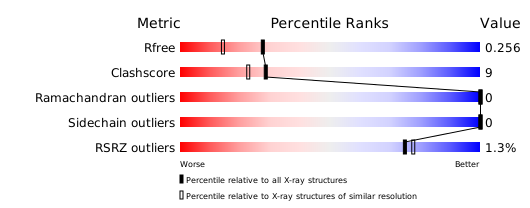
Structure validation
Download full validation report


